
Photo courtesy: Executive Mansion Press
Press Release
January 19, 2026
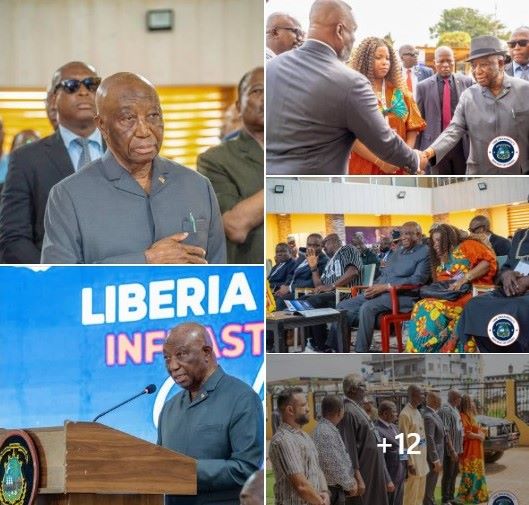
Executive Mansion, Monrovia — President Joseph Nyuma Boakai, Sr., has called on Liberians to place strong and sustained emphasis on the development of quality infrastructure, noting that sound infrastructure is a foundation for national prosperity and inclusive growth.
The President made the call on Monday, January 19, 2026, in Gompa City, Nimba County, during the opening of the National Infrastructure Conference, a forum aimed at strengthening Liberia’s approach to infrastructure planning and development.
President Boakai said Liberians must build infrastructure that meets international standards, is resilient to climate change, generates employment, stimulates enterprise, and promotes equitable growth.
“Yes, we must build back and build better,” the President said, stressing, “Build better in the sense that the infrastructure we build today and tomorrow must compete with the rest of the world, be resilient to natural elements and climate change, generate jobs, grow industry, stimulate enterprise, promote growth equity, and, more crucially, build a cohesive and open society, with no one left behind.”
Referencing former United States President John F. Kennedy, President Boakai quoted, “American roads are not good because America is rich, but America is rich because American roads are good.” He added that Liberia, too, will become wealthy and prosperous when it commits itself to building and maintaining good infrastructure.
The Liberian Leader noted that the National Infrastructure Conference aligns with the vision of the ARREST Agenda and his Administration’s approach to deliberate, inclusive, and forward-looking development, consistent with Africa’s Agenda 2063 and the Sustainable Development Goals.
He urged Liberians to move beyond fragmented efforts and short-term solutions toward coordinated systems that make use of modern technology and innovation to serve both present and future generations.
“The moment demands readiness — of our institutions, our policies, and our leadership,” President Boakai said, describing the Conference as a national call to action.
President Boakai explained that the Conference was conceived out of his deep concern over the visible deterioration and unsightly condition of Liberia’s infrastructure, a legacy of years of civil conflict, and as part of a forward-looking strategy to shape the future of the country’s infrastructure landscape.
“I am pleased to address this important Conference, which has been in the making for nearly two years,” he said. “MHe furthered, “It was conceived in response to my deep concern over the visible deterioration and unsightly state of our national infrastructure that persist as a legacy of our conflict. It is also the result of a forward-thinking approach to set the stage for how we intend to shape the future of our infrastructure landscape.”
The President stressed that infrastructure development must go beyond physical assets and reflect a human-centered approach that protects dignity and secures the future of the nation.
“We should see roads and bridges beyond concrete and steel; energy systems beyond wires and turbines; and water systems beyond pipes,” he said, adding, “They are the lifelines that shape opportunity, productivity, and national confidence.”
Speaking candidly, President Boakai acknowledged that deteriorated roads, decaying public buildings, unreliable electricity, and limited access to safe water, sanitation, and adequate housing have imposed daily hardship on Liberians and constrained economic growth.
“Across Liberia, until recent efforts to stop the rot, roads have been in a deteriorated state, public buildings have decayed, electricity has been unreliable, and access to safe water, sanitation, and adequate housing has been far from universal,” he said.
He said the Conference is intended to foster an honest national dialogue that confronts the decay of the nation’s infrastructure, identifies priority areas for repair, and charts a clear path toward rebuilding smarter and better.
“The purpose is not simply to repair what is broken,” the President said, “but to design infrastructure that improves lives and restores dignity.”
President Boakai further noted that Liberia’s post-conflict experience underscores the urgency of concrete infrastructure development, as years of civil war destroyed infrastructure that once symbolized national pride.
He encouraged that “While these scars remain visible, they also present an opportunity to start again and build better.” In this context, he noted rebuilding infrastructure is also an act of national healing.”
The President concluded by stating that his Administration will continue to place infrastructure development at the center of national recovery, economic transformation, and long-term stability, as Liberia works to rebuild stronger systems that serve the people and secure the nation’s future.