
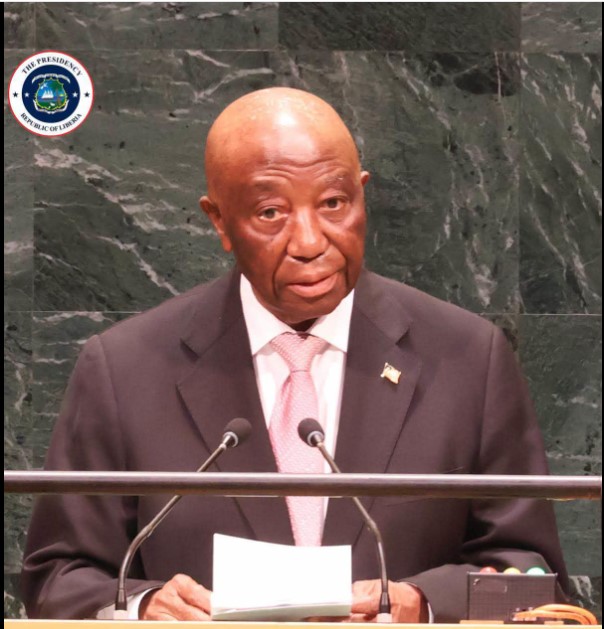
Says, “No Nation Can Police Global Criminal Networks Alone”
New York, USA–President Joseph Nyuma Boakai, Sr., has called for an international support to help Liberia confront mounting security threats, finance national development, respond to climate vulnerability and build the technological capacity required to compete in a rapidly changing world.
Addressing the general debate of the 81st Session of the United Nations General Assembly on Thursday, September 34, 2026, the Liberian Leader termed international partnership as critical to consolidating Liberia’s post-war gains, stating that several of the challenges facing the country cannot be effectively addressed through domestic resources alone.
The President said that, as an elected member of the United Nations Security Council for the 2026–2027 term, Liberia is taking part in international deliberations on peace and security while confronting threats closer to home, including transnational organized crime, cyber warfare and illicit narcotics trafficking along maritime corridors in the Gulf of Guinea.
President Boakai added that Liberia’s joint security forces are intensifying efforts against transnational drug networks, warning that the nature of the threat demands capabilities that exceed the reach of individual states. “No nation can police global criminal networks alone,” he told world leaders.
He then called on international partners for targeted assistance in coast-guard surveillance, intelligence-sharing and port-security technologies, seeking practical support to strengthen Liberia’s ability to secure its maritime space and disrupt criminal networks operating across national boundaries.
The President also added that Liberia is faced with financial constraints that threaten the nation’s ability to sustain development. He asserted that developing countries are entering the final years of the 2030 Agenda under growing debt pressures, shrinking fiscal space and repeated external shocks.
“Developing nations need concessional financing, debt sustainability, and predictable development capital, not escalating interest rates that threaten survival,” he suggested.
He said his Administration is pursuing the ARREST Agenda for Inclusive Development to address challenges across Agriculture, Roads, Rule of Law, Education, Sanitation and Tourism, while pointing to progress in revenue administration and infrastructure, including rural roads linking farms to markets.
The Liberian Chief Executive intimated that countries such as Liberia require an international financing environment capable of supporting, rather than constraining, those efforts.
He called for reform of the global financial architecture and greater representation for developing countries in the governance of the World Bank and International Monetary Fund. “A financial system that decides the fate of billions cannot continue to be governed by so few,” he warned.
On climate vulnerability, the President told the Assembly that Liberia contributes virtually nothing to global emissions but is already experiencing the consequences of a warming planet through coastal erosion, flooding and disruptions to agricultural cycles.
He added that Liberia carries an environmental responsibility of international significance, pointing out that the country contains 42 percent of the remaining Upper Guinean Rainforest, making the preservation of Liberia’s forests a matter with implications beyond the country’s borders.
President Boakai noted that Liberia should not be expected to carry the economic and environmental costs of protecting such resources without corresponding international support. “Climate responsibility must be paired with climate justice,” he opined.
The President reminded industrialized nations to honor their climate-financing commitments and operationalize loss-and-damage mechanisms, seeking greater assistance for countries experiencing severe climate impacts despite contributing relatively little to their causes.
On human capital, the President viewed it as an area where international cooperation could help determine Liberia’s future.
With more than 60 percent of Africa’s population under 25, President Boakai called for expanded investment in STEM education, digital literacy and technical training so that young Africans can participate in the global economy as innovators and skilled workers.
“Young people must become co-creators in the global digital economy, not just consumers,” he said, arguing that artificial intelligence and technological revolution could deepen existing inequalities if developing countries lack the resources and expertise to participate in shaping emerging technologies.
President Boakai added his voice to calls for stronger ethical standards and regulation of artificial intelligence, particularly its use in warfare, while advocating assistance that would enable developing countries to build their own technological capabilities.
He conclued by reminding the Assembly that Liberia emerged from years of civil conflict to rebuild its constitutional institutions and democratic system, presenting that experience as evidence of what sustained national and international engagement can achieve.