
ANALYSIS By Austin S. Fallah
“Many of us are guilty of these comparisons, but as one becomes intellectually prudent, with an open, informed academic mindset, the trajectory has changed or must change.” – Austin S Fallah
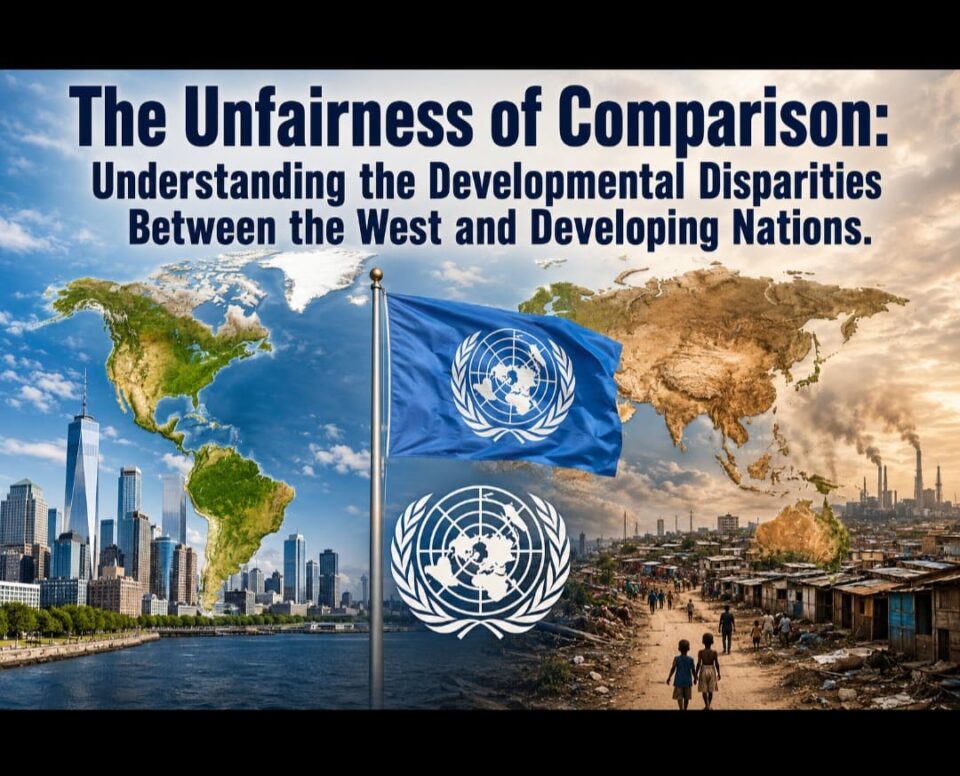
Comparing developing nations to the West using identical developmental metrics is inherently unjust.
It equates long-term, historically advantaged Western powers with regions still dismantling colonial legacies and systemic resource extraction.
This false equivalence ignores systemic global hurdles and masks unequal power dynamics.
Julius Nyerere (Former President of Tanzania): “You can not develop a country by remote control. And yet this is what we are being asked to do… We are being asked to believe that the gap between rich and poor countries is an inevitable result of differences in capacity or effort. It is not. It is the result of a system which operates to the advantage of the rich and to the disadvantage of the poor.”
Kwame Nkrumah (First President of Ghana): “The essence of neo-colonialism is that the State which is subject to it is, in theory, independent and has all the outward sovereignty of its state; in reality, its economic system and thus its political policy is directed from outside.”
Jason Hickel (Anthropologist & Author of The Divide): “Wealthy industrialized nations have historically profited from colonial exploitation and continue to do so through oppressive global financial and trade systems.”
Walter Rodney (Historian & Author of How Europe Underdeveloped Africa): “The colonial system was not an agency of ‘civilization’ but an instrument of economic exploitation and political subjugation, which systematically drained wealth from the periphery to the core.”
Michael Parenti (Political Scientist): “We are asked to believe that poor countries are poor because their lands have always been infertile or their people unproductive… The Third World is rich. Only its people are poor—and it is because of the pillage they have endured.”
Chinua Achebe (Nigerian Novelist): “The whole idea of a ‘developing nation’ is built on the premise that Western culture is the standard by which all human progress is evaluated—a fallacy that erases the rich, complex histories and values of the non-Western world.”
W.E.B. Du Bois (American Sociologist & Poet): “We the darker ones come even now not altogether empty-handed: there are today no truer exponents of the pure human spirit… Will America be poorer if she replaces her brutal dyspeptic blundering with light-hearted but determined humility?”
Noam Chomsky (Philosopher & Linguist): “There are no poor countries—only systems that have failed to manage resources.”
Amartya Sen (Philosopher & Economist): “Inequality causes problems by creating fissures in societies, leaving those at the bottom feeling marginalized or disenfranchised. We need to ask the moral questions: Do I have a right to be content living in a world with so much poverty and inequality?”
By: Austin S Fallah – A True Son of the Planet Earth Soil:fallahas@yahoo.com.
In an increasingly globalized world, it is common to hear discourses that compare the economic, social, political, and developmental landscapes of the West with those of developing nations.
Such comparisons often stem from a fascination with what has been perceived as the achievements of Western civilization: democracy, economic prosperity, technological advancement, and social freedoms.
However, while it is prudent to appreciate the wisdom and methods employed by Western nations in achieving their status, it is equally important to recognize that these nations have undergone decades, if not centuries, of gradual development.
Asserting the complexity of comparing these different trajectories and realities illuminates why it is not only inappropriate but also counterproductive to hold developing nations to the same standards that the West has set for itself.
One significant aspect of this discourse is the assumption that the West’s developmental model should be the universal yardstick for success.
This overlooks the lengthy and intricate historical processes that shaped Western societies.
The rise of Western civilization was not instantaneous; it was built upon the foundations of critical thought, philosophical discourse, and prolonged struggles for societal organization and governance.
The Enlightenment, the Industrial Revolution, and numerous civil rights movements are all part of this narrative that cannot be reduced to mere economic statistics or political structures.
Instead, they emerge from a deeply embedded history of trial and error, innovation, and philosophical evolutions in which Western nations gradually shaped their governance systems.
Furthermore, the cardinal principles that enabled the West to prosper, such as critical thinking, innovation, jurisprudence, accountability of leaders, and respect for human rights, are not merely attributes to be applied uniformly across the globe.
Each developing nation has unique sociopolitical contexts, histories, and cultural nuances that require a more tailored approach to development.
The reliance on a one-size-fits-all comparison simplifies the complexities of global development.
It fails to appreciate the diversity found in the efforts of developing countries to improve their circumstances.
At the heart of this debate are the fundamental questions of what constitutes successful governance and development.
Given the historical context in which the West has flourished, proposing that developing nations should emulate Western models without considering their specific needs and circumstances is not only unwise but unfair.
Countries in the Global South often grapple with legwhich acieswhich of colonialwhichism, socio-economic disparities, and ongoing conflicts that shape their quests for stability and prosperity.
Insisting that they align strictly with Western ideals of progress without recognizing these unique challenges is both solipsistic and damaging.
Moreover, when specifically addressing the social elements of comparison, it is essential to clarify the role of economic empowerment, infrastructure development, and the protection of human rights, especially for marginalized groups such as women and children.
The West’s success owes much to its infrastructure and social safety nets, developed over centuries.
Conversely, developing nations frequently contend with persistent poverty, inadequate infrastructure, and systemic inequalities that require holistic approaches rather than simple metrics of comparison.
This discrepancy imposes a moral obligation on those in the West who advocate comparisons; they must ensure their criticisms are informed by an understanding of the challenges hindering developing nations.
In my law school class on negotiations, at Hamline University School of Law on the Sudan crisis, I opined that discussions concerning economic empowerment in developing nations, it is crucial to recognize the importance of job creation and the provision of essential services, such as electricity and transportation, were central to negotiation in ending the crisis.
The establishment of fair employment opportunities increases individuals’ economic agency, thereby enabling improvements in living standards and overall community development.
For instance, countries that have invested in renewable energy initiatives are not only addressing pressing environmental concerns but are also creating jobs and fostering economic growth.
As developing nations establish policies to promote economic growth and social welfare, it is beneficial for them to learn from the experiences of Western nations.
However, this should be done in a spirit of encouragement and learning rather than rigid comparison.
Western nations can serve as models of innovation in technology and governance practices.
Yet developing nations must have the agency and support to forge their unique paths tailored to their distinct cultural, social, and political realities.
Equally significant is the ongoing fight against corruption and the demand for accountability within leadership structures.
The West has often touted democracy as a virtue, but democracies do not spring fully formed from the ground without strenuous effort.
The gradual establishment of checks and balances, fair governance, and public accountability are principles that developing nations must also imbue within their efforts.
The rhetoric of comparison should never overlook the support required to cultivate a strong civil society, strengthen legal frameworks, and ensure that the voices of the populace are heard.
Moral imperatives extend beyond governance into the realm of human rights, particularly regarding vulnerable populations.
Developing nations often face the dual challenge of advancing human rights while navigating the socio-economic constraints typical of their circumstances.
For instance, women and children in these regions bear the brunt of socio-economic disparities and are thus disproportionately affected by policy decisions.
If that is the West that has championed certain rights, the implication should not be a singular push for identical standards but rather a shared insight into achieving similar rights while respecting local contexts.
Buy and read my book: Labor Patterns of Economic Growth: Navigating the Way to Economic Freedom of Developing and Third-World Countries.
Reflecting on the unfairness embedded in comparisons, it is imperative to consider the consequences of setting unreasonable benchmarks.
When developing nations are assessed solely by Western standards, it may inadvertently reinforce feelings of inadequacy and despair among citizens and leaders alike.
A continuous comparison may trap developing countries in a double bind, where they struggle not only to innovate and adapt to their unique situations but also to overcome external perceptions of failure or inferiority.
Encouragement, rather than stringent comparison, can yield beneficial outcomes for developing nations, allowing them to adopt successful practices from the West while retaining their cultural integrity and addressing local challenges meaningfully.
This includes focusing on building sustainable institutions, enhancing educational opportunities, and fostering community-driven initiatives that resonate with each nation’s unique social fabric.
To summarize this disquisition, I will say that while recognizing the accomplishments of Western countries offers educational insights, it is crucial to approach comparisons with fairness and awareness of their varying contexts.
The best practices and principles cultivated in the West can guide developing nations, but holding them to those same standards is not only unjust but counterproductive.
Following the principle that development is a journey, each nation must forge its path, equipped with the wisdom gleaned from global experiences but firmly rooted in its realities.
Such an approach fosters a spirit of international collaboration, mutual respect, and a shared vision for progress that transcends mere comparison, positioning every nation to aspire to its unique version of prosperity and success.