
By Austin S Fallah – A True Son of the Planet Earth Soil: fallahas@yahoo.com
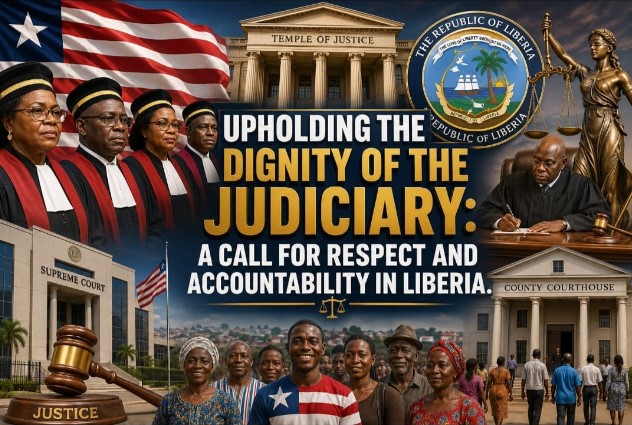
Upholding judicial dignity requires balancing institutional respect with public accountability, as highlighted by prominent legal minds in Liberia and globally.
President Joseph Nyuma Boakai: Addressing the role of the courts: The Judiciary stands as the ultimate guardian of liberty and fairness… If our courts are strong, our nation will flourish. If they are weak, the foundation of our democracy will not endure.”
Zero Tolerance for Corruption: Chief Justice Yamie Quiqui Gbeisay emphasized a national covenant to eradicate corruption within the courts, introducing systemic transparency measures while stressing that directives from the bench remain binding to preserve order.
The Supreme Court of Liberia Code of Moral and Professional Ethics (Rule 1 & Rule 2):It shall be unprofessional for any lawyer to advise, initiate, or ot,herwise participate directly or indirectly in any act that tends to undermine or impugn the authority, dignity, or integrity of the courts or judges, by hindering the effective administration of justice.”
The Supreme Court as “Country Devil”: Former Chief Justice Gloria Musu-Scott described the apex court as Liberia’s cultural “devil”—an institution that must be dressed up or respected in public rather than stripped of its authority, cautioning that lawyer professional ethics bars lawyers from undermining judicial independence.
Cllr. Tiawan Saye Gongloe (Liberian human rights lawyer and legal scholar):Respect for the judiciary is not optional; it is foundational to constitutional governance and the preservation of the rule of law.”He further noted regarding limits on public attacks: “Contempt is not about protecting personal pride. It is about protecting the administration of justice.”
Heightened Duty for Counsel: In precedents such as In re Cllr. C. Abayomi Cassell, the Supreme Court of Liberia, established that public officials and legal professionals carry a strict obligation to preserve judicial integrity, ruling that unfounded public accusations by officers of the court threaten public confidence.
Lord Denning (Master of the Rolls, United Kingdom, R v. Metropolitan Police Ex p. Blackburn, 1968):”It is a right of every man, in free country or which we are, to make fair comment, even outspoken comment, on matters of public interest. But it is the one thing which is wrong to attack the integrity of the judge, or to suggest that this course of conduct is misdirected.”
The Bangalore Principles of Judicial Conduct (2002) (Value 1: Independence & Value 6: Decorum):”A judge shall exhibit and promote high standards of judicial conduct in order to reinforce public confidence in the judiciary which is fundamental to the maintenance of judicial independence.”
The judiciary forms the bedrock of democracy and the rule of law in any nation.
In Liberia, the integrity and reputation of the judiciary are currently under unprecedented threats due to a pervasive culture of disdain toward it.
An alarming trend has emerged whereby unverifiable statements and malicious narratives are crafted and disseminated to undermine Supreme Court justices and judges of subordinate courts.
This contempt for the judiciary undermines not only its authority and functionality but also erodes public trust in a vital institution that is supposed to ensure justice and fairness.
Additionally, the issue of falsely accusing judges or creating narratives that assail the characters of these legal officials must be addressed with urgency.
Such actions are not an exercise of free speech but rather an insidious form of character assassination that can and should be met with accountability under the law.
The Constitution of Liberia affirms the right to free speech but confines it within the parameters of respect, integrity, and truth.
Understanding Free Speech Under the Liberian Constitution:
Articles 15-20 of the 1986 Constitution of Liberia state, “Article 15:
- Every person shall have the right to freedom of expression, being fully responsible for the abuse thereof. This right shall not be curtailed, restricted, or enjoined by government save during an emergency declared in accordance with this Constitution.
- The right encompasses the right to hold opinions without interference and the right to knowledge. It includes freedom of speech and of the press, academic freedom to receive and impart knowledge and information, and the right of libraries to make such knowledge available. It includes non-interference with the use of the mail, telephone, and telegraph. It likewise includes the right to remain silent.
- In pursuance of this right, there shall be no limitation on the public right to be informed about the government and its functionaries.
- Access to state-owned media shall not be denied because of any disagreement with or dislike of the ideas expressed. Denial of such access may be challenged in a court of competent jurisdiction.
- This freedom may be limited only by judicial action in proceedings grounded in defamation or invasion of the rights of privacy and publicity or in the commercial aspect of expression in deception, false advertising, and copyright infringement.
Article 16:
No person shall be subjected to interference with his privacy of person, family, home or correspondence except by order of a court of competent jurisdiction.
Article 17:
All persons, at all times, in an orderly and peaceable manner, shall have the right to assemble and consult upon the common good, to instruct their representatives, to petition the Government or other functionaries for the redress of grievances and to associate fully with others or refuse to associate in political parties, trade unions and other organizations.
Article 18:
All Liberian citizens shall have equal opportunity for work and employment regardless of sex, creed, religion, ethnic background, place of origin or political affiliation, and all shall be entitled to equal pay for equal work.
Article 19:
No person other than members of the Armed Forces of Liberia or of the inactive service shall be subject to military law, or made to suffer any pains or penalties by virtue of that law, or be tried by courts-martial.
Article 20:
- No person shall be deprived of life, liberty, security of the person, property, privilege or any other right except as the outcome of a hearing judgment consistent with the provisions laid down in this Constitution and in accordance with due process of law. Justice shall be done without sale, denial or delay; and in all cases not arising in courts not of record, under courts-martial and upon impeachment, the parties shall have the right to trial by jury.
- The right of an appeal from a judgment, decree, decision, or ruling of any court or administrative board or agency, except the Supreme Court, shall be held inviolable. The legislature shall prescribe rules and procedures for the easy, expeditious, and inexpensive filing and hearing of an appeal.”
However, these provisions, particularly Article 15, are not a blanket allowance for any speech, especially when it crosses into falsehood and malice.
The clause (Article 15) is explicitly intended to promote the free exchange of ideas, not to facilitate the character assassination of individuals, particularly those who bear significant public trust, like judges and government officials.
In essence, the core tenets of free expression and freedom to speak one’s mind and criticize authorities are not limitless; they exist within the framework of responsibility and truthfulness.
The Constitution does not endorse slander, defamation, or any form of communication that aims solely to mislead the public, falsely malign individuals, or obscure the truth.
Global Perspectives on Defamation of Judicial Officials:
This phenomenon of intentionally discrediting judicial officials is not unique to Liberia; it is a global issue, manifesting in various contexts across different nations.
A strong example of legal repercussions for this form of defamation can be observed in the United States. In “In re Hinds”, 128 F.3d 81 (4th Cir. 1997), a lawyer was held in contempt of court for making false statements about a judge’s integrity.
The court noted that the judiciary must operate in an environment of respect and authority and that any attempt to undermine judges through lies was unacceptable for the functioning of justice.
In addition, the case of “Henry v. State”, 990 So. 2d 222 (Fla. 2008), shows a situation where an individual was prosecuted for making false statements about a judicial official that amounted to bringing disrepute to the court.
The ruling emphasized that judges, like any professionals serving in public office, deserve protection from unfounded attacks on their character, which ultimately undermine the impartiality of the judiciary.
International law similarly supports the notion that falsehoods directed at public officials, including judges, can result in legal consequences.
The European Court of Human Rights, in cases involving the defamation of judges, has ruled that while free speech is essential, it does not extend to malicious accusations that lack verifiable truth.
In “M.A. v. Italy, “the court affirmed that freedom of expression is not a shield for contempt or a tool to undermine the operation of justice.
Implications of Character Assassination:
The act of character assassination against judicial figures has far-reaching implications.
When judges and justices are subjected to false accusations emanating from public dissent or political maneuvering, it not only tarnishes their reputation but also poses a significant threat to the administration of justice.
Public faith in the integrity of the judiciary wanes, leading to a chilling effect in which legal officials may hesitate to render impartial judgments out of fear for their standing in the community.
Moreover, an erosion of trust in the judiciary complicates the societal fabric that holds together the ideals of democracy and accountability.
Individuals may begin to question the legitimacy of court rulings, and citizens may feel disillusioned and disenfranchised, believing they cannot receive fair treatment under the law.
The notion that every citizen is entitled to a fair trial, presided over by an impartial adjudicator, becomes compromised when the judiciary is perceived as corrupt because of baseless allegations and unverified claims.
Demanding Accountability and Respect:
As citizens of Liberia, it is incumbent upon everyone to foster a culture that unequivocally demands respect for the judiciary and accountability for those who engage in malicious or slanderous behavior against judges.
The courts are integral to Liberia’s functioning democracy; without them, governance degrades into chaos.
An independent judiciary should be regarded as an institution of great repute and integrity, one that deserves public support, scrutiny based on facts, and protection from harmful attacks.
The judiciary must take the lead in reinforcing its authority to hold individuals accountable when they malign it without justification.
The judiciary can implement more robust mechanisms to deal with contempt of court, going beyond mere admonishment to ensure that people who engage in slanderous acts face legal consequences for their actions.
This may involve collaborating with law enforcement to investigate cases in which judges are publicly defamed or routinely discredited without due cause.
Additionally, the legal community in Liberia should work towards educating citizens about the meaning of free speech in the context of judicial respect.
Public workshops, community forums, and information campaigns should aim to clarify the boundaries of free expression, stressing the importance of truthfulness and respect for civil servants, especially those in the judiciary.
While the rights enshrined in the Constitution of Liberia allow for free expression, it is essential to recognize that not all speech enhances democratic discourse.
Intentionally spreading lies against judges operates outside the bounds of constitutional free speech.
It is character assassination that undermines the very foundations of justice and democracy that Liberia seeks to uphold.
The judiciary must assert its authority and demand respect from every Liberian, making it known that the dissemination of unverifiable statements aimed at judges will not be tolerated.
This is not merely an issue of the judiciary’s authority but also a matter of public responsibility to ensure that the truth, justice, and integrity prevail within our legal system.
To safeguard the judiciary’s future and strengthen democracy in Liberia, Liberians must stand against the tyranny of lies and embrace the principles of truth and honor.