
By Austin S. Fallah – A True Son of the Planet Earth Soil: fallahas@yahoo.com
President Joseph Nyumah Boakai:
“We must continue to irreversibly latch ourselves onto the budding democratic culture sprouting from the rubble of a most tragic and costly 14-year civil war.” — Joseph Nyuma Boakai, Inaugural Address, January 22, 2024.
The Executive Mansion
Application: Democratic culture requires truth, accountability, and institutions that serve the entire nation—not merely the interests of those in power.
Former US President Abraham Lincoln: “You can fool all the people some of the time, and some of the people all the time, but you cannot fool all the people all the time.” — Abraham Lincoln, attribution widely circulated; exact historical provenance is disputed.
Application: Political deception may temporarily mislead citizens, but sustainable national development depends on institutions that establish facts and hold public officials accountable.
Former South African President Nelson Mandela: “A good head and a good heart are always a formidable combination.” — Nelson Mandela, Long Walk to Freedom (1994).
Application: Liberia’s development requires both competent leadership and moral integrity. Economic growth without honesty cannot produce lasting public trust.
George Washington, United States First President: “Truth will ultimately prevail where there is pains taken to bring it to light.” — George Washington, letter to Charles M. Thruston, August 10, 1794.
Application: Truth-telling must be supported by independent courts, responsible journalism, transparent public accounts, and citizens willing to demand evidence.
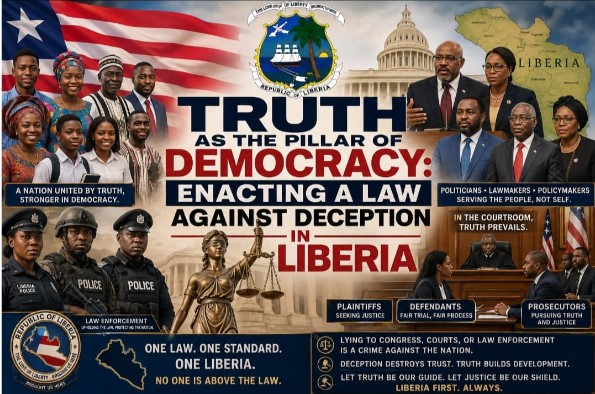
Hon. Alexander Torbor Kun; “Truth as the Pillar of Democracy: Enacting a Law Against Deception in Liberia. No member of Congress, public official, or private citizen should knowingly mislead a court, a lawful investigation, or the national legislature when the law requires truthful testimony. Accountability must protect the entire nation, not merely those who hold power.”
Examples of conduct that should be criminalized, subject to due process and the precise language of an enacted statute, include:
Lying to the National Legislature: Knowingly giving false testimony during a lawful legislative investigation, such as falsely denying the misuse of public funds.
Lying to judges or courts: Knowingly submitting a false affidavit or giving deliberately false testimony in a judicial proceeding.
Lying to law enforcement: Knowingly making a materially false statement during a lawful investigation where the law specifically makes that conduct an offense.
False public financial reporting: Knowingly falsifying official records or financial disclosures required by law.
In a time when societies are grappling with erosion of trust, the call for integrity has never been more pressing.
Establishing a law that makes lying to the National Legislature, National Security Apparatus, Judges, and Courts a national crime in Liberia is not merely a legal adjustment; it is a transformative necessity.
Such a law, carrying a penalty of ten years’ imprisonment, a fine of US$10,000.00, and a requirement for a public letter of apology published in national and international dailies, aims to reinforce the foundations of democracy and the rule of law in Liberia.
By embedding truthfulness into the fabric of governance, this initiative will not only bolster respect for legislative, judicial, and security institutions but also ingrain respect for truth as a cornerstone of democracy among all Liberians.
To weave this vision into reality, Liberians must recall the wisdom of the ages.
Thinkers like Niccolò Machiavelli and Socrates have articulated views on governance, power, and the essentiality of truth.
Machiavelli famously stated, “The ends justify the means,” but in the context of transparent governance, the end must also be rooted in honor and honesty.
For any government to govern effectively, it must command respect, and respect is cultivated through trustworthiness.
Socrates championed integrity, positing that “The greatest way to live with honor in this world is to be what we pretend to be.”
If public officials act dishonestly, they not only corrupt their image but also jeopardize the very structure of democracy.
Liberia has endured its share of turmoil and strife, and part of the healing process involves a commitment to truth and honesty by those who govern.
The proposed legislation must extend to every government employee, including local elected officials in traditional capacities, ensuring that every citizen stands accountable to the law.
By allowing no exception for power or position, this law will also reflect the principle of equality before the law, echoing the adage that “a liar must at least be a man of courage,” while pricking the facade of deceit that often masquerades as governance.
African proverbs resonate deeply with this aspiration; they remind us of our cultural lineage of respect for authority and truth.
For instance, the Ethiopian proverb, “He who tells a lie does justice to his enemy,” highlights the futility of deceit.
In a society where leaders perpetuate dishonesty, citizens learn to mistrust the authority meant to protect them.
Such principles of truth-telling must cascade from the heights of power to the depths of citizenship, a vital thread in the quilt of democracy.
Emphasizing the gravity of legal accountability not only reinforces the structure of governance but also dismantles the existing norm where dishonesty has become normalized.
Under the proposed law, sentences for perjury would serve as both punishment and deterrent.
A decade in prison, alongside hefty fines, sends a message of monumental significance: lying is not an innocuous transgression; it is a direct betrayal of public trust and, ultimately, democracy.
In a nation where trust in public institutions has been shaky, re-establishing this trust becomes the bedrock upon which a new Liberia in the 21st century is built.
To foster a culture where truth reigns is to acknowledge that complexity underlies the human experience.
Challenges will remain, but history shows that societies that uphold truth tend to flourish.
Imagine a Liberia where citizens can confidently engage with their government, one that answers truthfully, without fear of deceitful entanglements.
This vision rises above all political affiliations, reminding us that democracy and the rule of law are common threads binding every citizen, regardless of their personal or political circumstances.
Moreover, enacting such a law would align Liberia’s democratic values with universal principles.
Globally, transparency and accountability are lauded benchmarks of successful governance.
A commitment to truthfulness will not only elevate Liberia’s domestic image but also its stature on the world stage.
The international community favors ethical governance; thus, a legal framework that emphasizes honesty will draw potential investors and allies.
The economic boon that could follow the establishment of trustworthy institutions cannot be overlooked.
Enforcing this law will require widespread education on the importance of truth in governance.
To achieve this, civic education programs must be implemented in schools, enabling the next generation of leaders to cultivate respect for truth from an early age.
Workshops, community discussions, and partnerships with civil society organizations can foster robust discourse on the importance of honesty.
As Liberians engage with the tenets of democracy through the rule of law, principles of civic responsibility will be ingrained in the collective consciousness.
Furthermore, accountability mechanisms must be put in place to ensure that those within the power structure cannot escape the consequences of their dishonesty.
This reflects the wisdom of Socrates, who believed that “an unexamined life is not worth living.” Our leaders must be subjected to scrutiny and held to the highest standards.
Strengthening the independence of the judiciary and enhancing the capacity of national security officers are crucial components in achieving this vision.
As Liberia strives for an egalitarian society, every citizen must contribute to this ambition.
The law should create a public ethos that celebrates honesty and integrity as paramount virtues.
Each person, regardless of social status or influence, should recognize their capacity to uphold the truth.
This fosters a collective responsibility to ensure that governance reflects the needs and aspirations of all citizens.
Acknowledging that change does not occur overnight is essential, for the road to a new Liberia in the 21st century will undoubtedly encounter resistance from those who thrive in a veil of deceit.
Nevertheless, the pursuit of truth is a noble endeavor that aligns with the highest ideals of democracy.
Those ideals must power Liberia’s march forward, reinforcing a commitment to liberty, justice, and equality for all.
Notably, enacting this law will open new avenues of discourse about governance in Liberia.
Debates surrounding its implementation will stimulate conversations about ethical leadership and citizen responsibility.
A culture of accountability enhances societal resilience and cultivates commitment to community values.
Young people, in particular, will benefit from role models adhering to high ethical standards, fostering hope for a brighter future.
Ultimately, this initiative is about reimagining the trajectory of Liberia’s democratic evolution.
It speaks to a future where honesty becomes synonymous with leadership, where the most critical principle of governance, accountability, is upheld.
“Truth stands the test of time,” remarked the African proverb, and so it must.
For a nation emerging from the shadows of conflict and mistrust, this endeavor could mark the first steps toward an enlightened 21st-century Liberia, one that cherishes honesty, nurtures accountability, and celebrates democracy.
As Liberians embark on this quest, it is a collective aspiration that each citizen commits to uphold truth in both public and private spheres.
Let all Liberians establish frameworks that respect and enforce accountability, heralding a new era founded on integrity and the rule of law.
Enacting this law is not just a legal necessity; it is a moral obligation that reflects Liberians’ commitment to true governance.
With the unwavering belief that truth must guide Liberia’s path, Liberia can and will emerge as a beacon of hope and honesty in a world often marred by deception.