
The Public Interest Demands Transparency
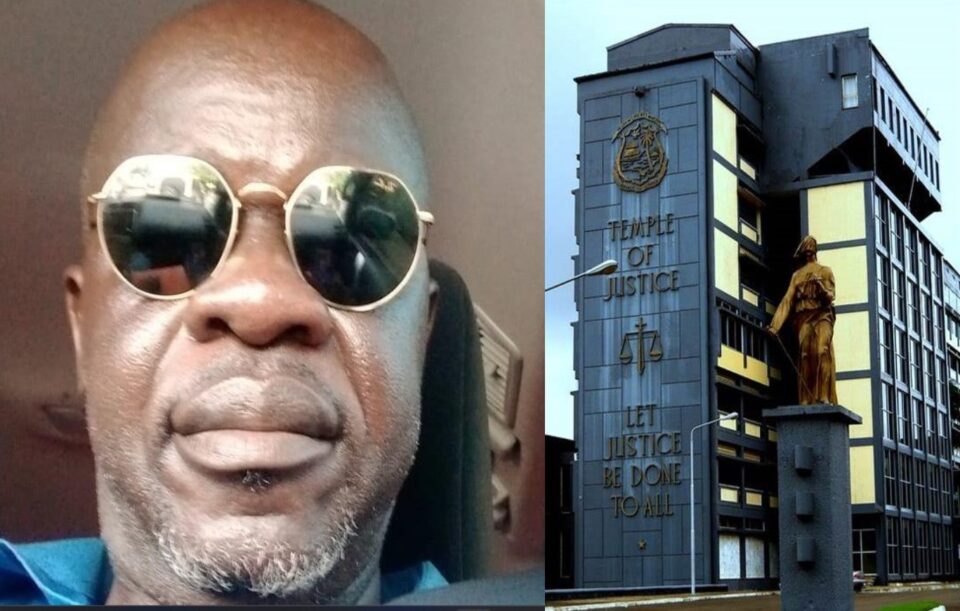
PHOTO: (L-R) Patrick Yattoh and the Temple of Justice, seat of the Liberian Judiciary
By Patrick M. Yattoh, Jr.
We respectfully call upon the Government of Liberia, the Judiciary, and the appropriate judicial authorities to consider allowing cameras in the courtroom and permitting the proceedings in this high-profile drug case involving the former Vice President and other defendants to be televised or livestreamed, subject to reasonable judicial safeguards.
This is not a call for a media spectacle, nor is it an attempt to interfere with the independence of the courts. On the contrary, it is an appeal for greater transparency, public confidence, and direct access to justice in a case of extraordinary national and international interest.
The public interest demands transparency
The allegations before the court are of profound public importance. They involve not only prominent public figures but also allegations relating to narcotics, the administration of justice, the integrity of public institutions, and the credibility of Liberia’s fight against corruption and organized crime.
In circumstances of such magnitude, Liberians should not be required to experience the trial primarily through political statements, social-media commentary, partisan interpretations, or second-hand accounts from journalists, lawyers, political actors, and other interested parties.
The public deserves the opportunity to see and hear the proceedings for itself.
A televised proceeding would allow citizens to observe the evidence as it is presented, listen to the arguments of counsel, hear the testimony of witnesses where legally permissible, observe the conduct of the prosecution and defense, and witness the rulings of the court directly. It would reduce the space for misinformation and help distinguish what actually occurs in court from what different actors subsequently claim occurred.
Public trials and the constitutional principle of openness
The request is also grounded in a fundamental principle of constitutional democracy: justice must not merely be done; it must be capable of being seen to be done.
Article 20 of the Liberian Constitution guarantees due process, while Article 21 expressly recognizes the accused’s right to a “speedy, public and impartial trial.” The Constitution also provides broad protections for freedom of expression and freedom of the press and recognizes the public’s right to be informed about government and its functionaries.
A public trial, however, should mean more than the physical presence of a limited number of people inside a courtroom. In the modern information age, meaningful public access can also include responsible technological access to proceedings of exceptional public significance.
Televising a trial would therefore not diminish the principle of a public hearing. Properly regulated, it could enhance that principle by making the judicial process accessible to citizens who cannot physically attend court.
We recognize the Judiciary’s existing rules
We acknowledge that Liberia’s Judiciary currently has rules that restrict photography and live broadcasting or televising of proceedings. The Judiciary’s General Rules state that such recording and broadcasting are not permitted, citing concerns including courtroom decorum, witness distraction, lawyer grandstanding, and the possibility of public misconceptions about proceedings. The Judicial Canons likewise contain restrictions concerning live broadcasts, electronic recordings, and photography.
Those concerns are legitimate and should not simply be dismissed.
But rules are ultimately instruments for the administration of justice. They should be interpreted and, where appropriate, reconsidered in light of changing technology, exceptional circumstances, and the public interest.
The question, therefore, should not necessarily be whether cameras must be permitted without restriction. The more constructive question is whether the Judiciary can establish a strictly controlled, judicially supervised system of broadcasting that protects the integrity of the proceedings while giving the Liberian people unprecedented access to a case of extraordinary national importance.
Safeguards can protect the integrity of the trial
If the Judiciary is concerned about cameras becoming disruptive, those concerns can be addressed through carefully designed protocols.
For example:
– The court could control all cameras and determine their location.
– A single official video feed could be produced by the Judiciary rather than allowing competing media crews inside the courtroom.
– The judge could retain absolute authority to suspend or terminate the broadcast whenever necessary.
– The identities or images of vulnerable witnesses could be protected where required by law.
– Sensitive evidence, confidential documents, or legally protected material could be excluded from the broadcast.
– Cameras could be prohibited from focusing on jurors, where applicable.
– No interviews, commentary, or demonstrations should be permitted inside the courtroom.
– The broadcast could be delayed by several seconds or minutes to permit the court to intervene if necessary.
– The media could be required to comply with a strict code of conduct.
– The official court feed could be archived as part of the historical record, subject to applicable law.
Such safeguards would allow Liberia to balance open justice with the rights of the accused, the protection of witnesses, judicial independence, and the orderly administration of justice.
The presumption of innocence must remain paramount
Importantly, televising the proceedings should not become a mechanism for convicting anyone in the court of public opinion.
Every defendant remains presumed innocent unless and until the prosecution proves guilt beyond a reasonable doubt in accordance with law. The cameras should therefore serve the opposite purpose of sensationalism: they should allow the public to observe the evidence and the legal process rather than rely upon accusations, counter-accusations, political rhetoric, or social-media narratives.
The prosecution should have to prove its case in court. The defense should have the opportunity to challenge the evidence. Witnesses should be examined and cross-examined according to law. And ultimately, the court—not politicians, journalists, social-media commentators, or the public—must determine guilt or innocence.
That is precisely why greater transparency can strengthen, rather than weaken, the administration of justice.
Liberia should not be afraid of an open courtroom
Around the world, societies have grappled with the question of whether cameras belong in courtrooms. The experience is mixed, and there are legitimate arguments on both sides. Even the United States has historically maintained restrictions on cameras in federal criminal proceedings, demonstrating that televised justice is not an uncomplicated issue.
At the same time, highly consequential trials in different jurisdictions have been made accessible to the public through television or other forms of electronic transmission, demonstrating that technology can be used to broaden public participation without necessarily sacrificing judicial control.
The widely remembered O.J. Simpson trial in the United States is one prominent example of a criminal proceeding receiving extraordinary television coverage. That experience also offers an important caution: cameras can illuminate the judicial process, but they can also create sensationalism. Liberia should therefore learn from both the benefits and shortcomings of televised trials rather than simply copying another country’s model.
An opportunity for Liberia’s justice system
This case presents an opportunity for Liberia to have a serious national conversation about open justice in the digital age.
The Liberian Judiciary already recognizes the importance of public information and has a Public Information function intended to facilitate communication between the courts, the media, and the public.
Rather than allowing information about an important trial to emerge principally through competing interpretations, Liberia could establish a transparent model in which the court itself becomes the authoritative source of the proceedings.
Such a system could become a model for future cases of exceptional national importance—not necessarily for every case, but for proceedings where the public interest overwhelmingly justifies expanded access.
This is bigger than one former Vice President
Ultimately, this request should not be understood as a demand to televise a particular politician because of his political status.
The principle should apply equally to any case involving extraordinary public interest.
If a former Vice President, senior government officials, business leaders, or other prominent persons are accused of serious crimes, the public should be able to trust that the proceedings are being conducted fairly and transparently. Equally, if ordinary citizens are accused of serious offenses that attract extraordinary public attention, the same principles of fairness and due process should apply.
The courtroom must remain neutral. The law must remain supreme. And the accused must remain presumed innocent.
But transparency should also be a defining characteristic of justice.
A respectful appeal to the Judiciary
We therefore respectfully urge the Chief Justice, the Supreme Court, the trial court, and the relevant authorities of the Liberian Judiciary to consider whether an exception, special protocol, or appropriate judicial mechanism can be established to permit the proceedings in this exceptional case to be broadcast to the Liberian people and the wider world.
If the present rules do not permit such broadcasting, we respectfully encourage the Judiciary to consider whether those rules should be reviewed in light of modern technology and the extraordinary public interest surrounding this proceeding.
At a minimum, the court could consider providing an official audiovisual feed, live audio, or another reliable form of real-time public access that preserves judicial control and protects the rights of all participants.
The objective should not be entertainment.
It should be transparency.
It should not be publicity.
It should be public accountability.
It should not be about helping the prosecution or the defense.
It should be about allowing the truth to emerge through the judicial process.
Liberia is a constitutional democracy. Its people have a legitimate interest in understanding how justice is administered in their name.
Let the evidence be heard in open court.
Let the lawyers make their arguments.
Let the witnesses testify.
Let the judge rule according to law.
And, where the law and judicial safeguards permit, let the Liberian people watch.
In a case of such profound national consequence, transparency should not be regarded as a threat to justice. Properly managed, transparency can be one of justice’s greatest protections.