By Austin S Fallah – A True Son of the Planet Earth Soil, fallahas@yahoo.com
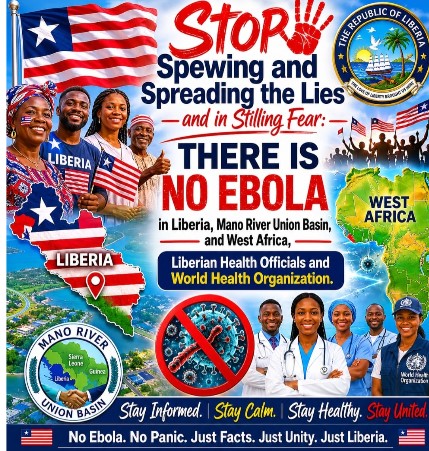
Ebola is not currently active in Liberia or West Africa. Liberian health officials recently issued a strict clarification that there are no suspected, probable, or confirmed cases of Ebola in the country.
While there is no Ebola in West Africa, the World Health Organization (WHO) has declared a public health emergency of international concern regarding a separate Ebola outbreak in Central Africa (affecting the Democratic Republic of the Congo and Uganda).
You can monitor global health updates and travel guidance on the World Health Organization website, or check local Liberian updates from the National Public Health Institute of Liberia for accurate regional information.
The Bible contains strong warnings about the dangers of deceptive speech and gossip, emphasizing that they lead to spiritual and social destruction.
Proverbs 6:16-19: Details the six things the Lord hates, two of which are “a lying tongue” and “a false witness who pours out lies.”
Proverbs 26:20 warns of the power of rumor: “Without wood a fire goes out; without a gossip a quarrel dies down.”
Ephesians 4:25: Dictates the necessity of honesty in a faithful life: “Therefore each of you must put off falsehood and speak truthfully to your neighbor, for we are all members of one body.”
President Joseph Nyuma Boakai spoke on World Press Freedom Day about how misinformation and disinformation undermine public trust and weaken democratic institutions.
President Joseph Nyuma Boakai: On the Danger to Democracy: “Misinformation undermines public trust and weakens democratic institutions. We must build a society where facts and respect for our traditional values matter. Criticism is not a threat to democracy; it is an essential tool to reawakening leaders.”
President Boakai: On Combating Deception: He has continuously called on media houses to uphold ethical reporting and fact-checking, stating that “we must improve professionalism, [and] combat misinformation” to preserve the nation’s democratic gains.
Former President George Weah: He has frequently criticized false narratives and health rumors spread by political opponents. Following baseless rumors about his health, he denounced the spread of fake news and urged his followers to reject propaganda.
Former President Weah: On the Danger of False Witnesses: “A lying tongue and false witness are among the seven things God hates. Proverbs 12:22 says, ‘Lying lips are an abomination to the Lord.”
Former President Weah: On the Danger to Peace: Addressing individuals who incite citizens against the government, he warned: “Whatever happens, we must make sure that we promote peace and unity amongst our people. Because what you fight for, you might be in the position one day. And only God knows what happens.”
Ellen Johnson Sirleaf, former President of Liberia & Nobel Peace Prize Laureate: Emphasized truth and transparency as essential for rebuilding societies, noting that fake news and rumors deeply undermine democratic development and peace.
Nelson Mandela, Former President of South Africa & Global Icon: Spoke frequently about how honesty, reconciliation, and integrity are the building blocks of a healthy society, contrasting the destructive nature of hatred and lies with the unifying power of truth.
Kofi Annan, former Secretary-General of the United Nations from Ghana, often warned that misinformation and propaganda are deadly threats to global peace, democracy, and human rights.
Plato: “False words are not only evil in themselves, but they infect the soul with evil.”
Niccolò Machiavelli: The Renaissance political philosopher focused on the pragmatic and calculated nature of deception, observing how easily the public can be misled: “Men are so simple and yield so readily to the desires of the moment that he who will trick will always find another who will suffer to be tricked.”
Jonathan Swift: “Falsehood flies, and the truth comes limping after it, so that when men come to be undeceived, it is too late; the jest is over, and the tale has had its effect.”
Mark Twain: “A lie can travel halfway around the world while the truth is putting on its shoes.”
William Shakespeare: Spoke of the insidious nature of rumor in Henry IV, Part 2, calling it “a pipe blown by surmises, jealousies, conjectures” that creates an atmosphere of panic.
“Undermining one another through lies and spewing fake and self-created rumors about others is responsible for young people and adolescent unproductivity in Liberia.” – Hon. Edward Wesee.
In today’s rapidly changing world, the power of information can not be overstated.
With the advent of social media and digital communication, news spreads like wildfire.
While this creates opportunities for rapid knowledge dissemination, it also opens the floodgates to a torrent of misinformation.
In Liberia, a country still healing from the wounds of civil conflict and public health crises, the proliferation of misinformation threatens to destabilize both national security and public health.
This korero will explore the imperative for Liberian youth, adults, and leaders to combat misinformation, promote critical thinking, and foster positive contributions to society.
Through examining the implications of fake news, the importance of credible information, and the necessity for community resilience, we can understand why the time has come for Liberia to prioritize truth and integrity in discourse.
Misinformation is not merely a nuisance; it is a vector for fear and division.
In Liberia, false narratives have emerged surrounding crucial issues such as public health, particularly concerning the Ebola virus. Claims that the World Health Organization (WHO) has not classified Liberia as Ebola-free are not only incorrect; they are dangerous.
Such misinformation can incite panic within communities, undermine trust in local health professionals, and divert attention from essential public health initiatives.
The people of Liberia have already endured significant trauma from previous epidemics; perpetuating falsehoods in this context reveals a lack of regard for the well-being of fellow citizens.
As a nation, Liberia must confront the negative implications of spreading lies and unfounded fears.
The act of sharing misinformation reflects a deeper issue that plagues society: a fundamental lack of critical thinking and discernment.
Critical thinking involves analyzing information, questioning assumptions, and evaluating sources before accepting claims as truth.
This cognitive skillset is essential in the digital age, where opinions are often mistaken for facts.
The youth and adults of Liberia must cultivate critical thinking as a civic responsibility.
By doing so, they not only enhance their understanding of current events but also contribute to a more informed society overall.
Moreover, the economic and social implications of misinformation are profound.
When people base their decisions on false information, they jeopardize their own growth and the nation’s development.
Misinformation can deter foreign investments, hinder collaboration with international organizations, and retard progress towards recovery and stability.
Instead of fostering innovation and competitiveness, spreading falsehoods detracts from valuable opportunities.
Liberians must replace the practice of indulging in misinformation with a commitment to sharing knowledge that uplifts and empowers.
To illustrate this point, consider the role of local health professionals and organizations in battling public health crises.
These individuals and groups operate under significant challenges, often working with limited resources and under the pressure of widespread fear.
When misinformation circulates, it undermines their efforts, as the community may hesitate to trust the guidance provided by professionals who have dedicated their lives to improving public health.
This is particularly disheartening, given that these health professionals are often the first responders during crises such as disease outbreaks.
By providing accurate information and clear communication, they can help to prevent panic and promote health-seeking behaviors.
Consequently, citizens need to support local professionals by amplifying their efforts rather than undermining them through misinformation.
Furthermore, uplifting narratives of strength, resilience, and progress deserve to take precedence over fear-mongering and falsehoods.
The time has come for Liberians to spread positivity and hope actively.
Instead of contributing to the fear that has plagued Liberia for far too long, innovative solutions, personal stories of triumph, and community successes should be the messages that are shared.
Through storytelling, citizens can highlight examples of how individuals and organizations are overcoming adversity and contributing to the nation’s growth.
This shift in approach could lead to a rejuvenated sense of national identity and pride, galvanizing the population to work towards common goals.
The promotion of truthful and constructive narratives aligns with a critical need for national unity in the face of adversity.
History has shown that misinformation can breed division, turning communities against each other and hindering collective efforts to overcome challenges.
The years of civil unrest in Liberia have left deep scars on the national psyche.
The healing process requires a commitment to speaking truthfully about the past, present, and future.
This means facing uncomfortable realities while also celebrating progress.
By fostering a culture of transparency and accountability, Liberians can lay a strong foundation for a collaborative future.
One way to strengthen community resilience is through education. Educational programs that teach media literacy can empower individuals to discern the validity of information.
Families, schools, and community organizations should prioritize teaching young people how to evaluate sources, fact check claims, and engage in responsible information sharing practices.
When citizens are equipped with the tools to assess information critically, they are less likely to unwittingly propagate misinformation.
An informed, educated populace can better resist the allure of lies, fostering a culture of accountability in information sharing.
In addition to education, leveraging technology to combat misinformation is critical to Liberia’s future.
The use of social media platforms, for example, provides an opportunity to disseminate accurate health information efficiently.
Public health organizations and the government can use these platforms to engage with communities in real time.
They can share updates, counter misinformation, and encourage community participation in health initiatives.
By promoting transparency and openness, the government can rebuild trust with its citizens.
This will create a united front against fear-based narratives that threaten progress.
Ultimately, it is a collective duty to confront misinformation with integrity and positivity.
The plea to “close your mouth if you have nothing positive to contribute” speaks volumes.
Each individual must reflect on their role within the community and consider the impact of their words.
Understanding that every statement can uplift or undermine empowers citizens to consciously craftke charge of thei.
Encouraging a culture where sharing useful, constructive, and truth-driven information becomes the norm will require conscious effort and commitment from everyone.
The path toward a resilient and unified Liberia necessitates an unwavering commitment to truth.
The relentless spread of misinformation poses a significant threat to public health and national security while enfeebling social cohesion.
Therefore, it is imperative that Liberians, especially the youth, engage in critical thinking, promote positive narratives, and support local health professionals.
By actively rejecting fear-mongering and embracing responsible information sharing, the citizens of Liberia can transform their society into one of resilience and positivity, one that honors the struggles of the past while forging a path towards a brighter future.
The time for action is now; each voice matters, and every contribution counts.
Let’s build a Liberia that is grounded in truth and driven by hope.