
An Editorial On Liberia’s National Flag Day
By Dr. J. Kerkula Foeday
Kerkula Foeday: Reflections & Impact, Issue 26, Monday, August 24, 2026
Today, August 24, Liberia raises its flag. Across the country, the Lone Star should rise above government buildings, schools, homes, businesses, and public spaces. School children are expected to march as it used to be before the war. Government officials will speak. Patriotic songs will be sung. Citizens will salute. Red, white and blue will once again become the dominant colors of our national imagination. And rightly so.
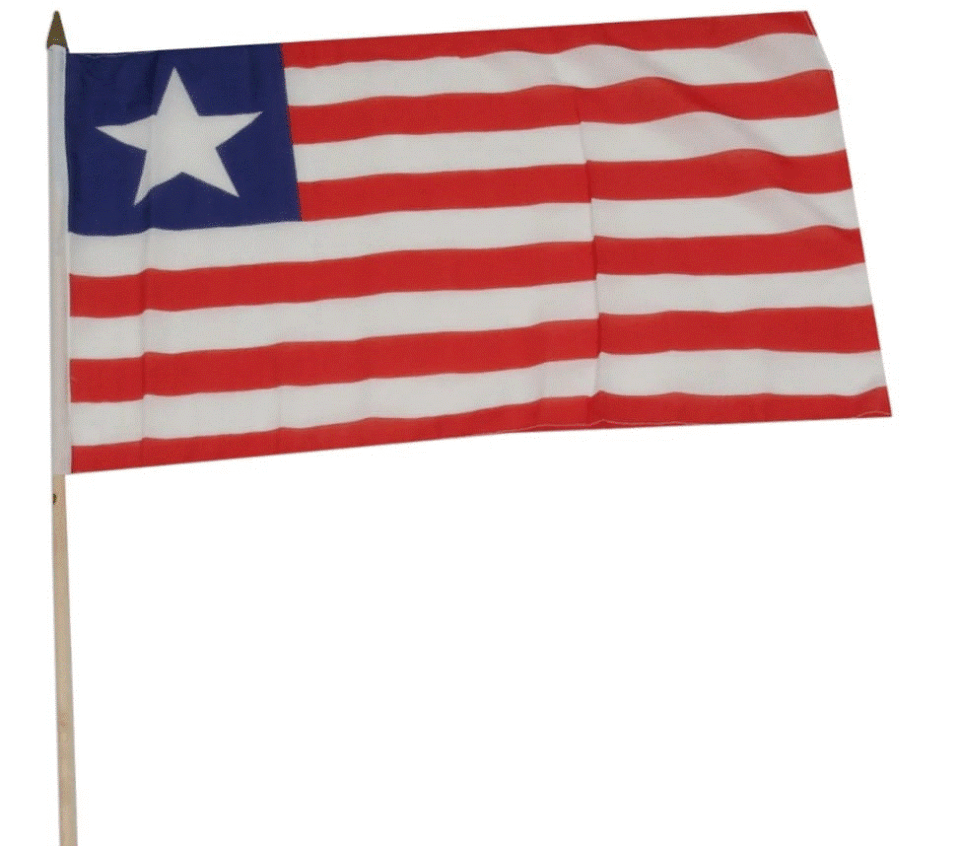
The Liberian flag is not an ordinary piece of cloth. It is one of the most enduring symbols of our national existence, sovereignty, independence, dignity and collective identity. Liberia adopted the flag on August 24, 1847, less than a month after declaring independence on July 26. It was designed and produced by a committee led by Susannah Lewis. The eleven stripes represent the eleven signers of the Declaration of Independence, while the lone white star in the blue canton represented Liberia’s unique status as an independent African republic at the time. Nearly seven decades later, the National Legislature formally established August 24 as National Flag Day through an Act approved on October 25, 1915. The day was designated a national holiday and intended to be observed as an expression of allegiance and loyalty to the national ensign, national pride and patriotism. For more than a century, therefore, Liberia has been raising this flag. But perhaps, after 111 years of officially celebrating Flag Day, we should ask a question that is more important than how high we raise the flag:
Are we still worthy of the values we celebrate?
That is the question I believe Liberia should confront today. Not as an exercise in pessimism. Not as an attack on our country. Not as an indictment of any particular political party, administration, ethnic group, religion or generation. But as an act of patriotism. Because genuine patriotism does not merely praise the nation. Genuine patriotism has the courage to examine the nation. And sometimes the most patriotic question a citizen can ask is the most uncomfortable one.
The flag must be more than a cloth. Let us begin with a simple truth: A flag is a cloth. It has no conscience of its own. It cannot be honest. It cannot be corrupt. It cannot show courage. It cannot betray. It cannot forgive. It cannot steal. It cannot sacrifice. It cannot serve. People do those things.
A flag becomes powerful because a people give it meaning. The Liberian flag becomes meaningful because generations of Liberians have attached to it memories of independence, struggle, sovereignty, sacrifice, freedom, dignity, national pride and the hope of a better future.
This means that every time we raise the flag, we are not merely displaying a national symbol. We are making a statement about the kind of nation we believe Liberia should be. And that creates an obligation. If we raise a flag that symbolizes liberty, we must practice liberty. If we raise a flag that recalls sacrifice, we must understand sacrifice. If we raise a flag associated with national unity, we must resist the forces that deliberately divide us. If we raise a flag associated with sovereignty, we must protect the institutions that make sovereignty meaningful. If we raise a flag that represents Liberia to the world, we must ask whether our conduct gives the world reasons to respect Liberia. The flag we raise should never become more honorable than the people who raise it.
The Three Colors: A Moral Reading of Liberia
The official historical descriptions of Liberia’s flag give specific meanings to its elements. The red stripes recall the blood shed in the struggle for independence; white represents the purity of mind and clarity of the forebears toward one another; and the blue field historically depicts the African continent. But national symbols can speak across generations. Their meaning can be remembered historically while also being interpreted morally for the present. And perhaps Liberia needs to hear its colors anew. For our generation and posterity, let blue challenge us to freedom, loyalty and justice. Let red challenge us to resilience and sacrifice. And let white challenge us to peace, honesty, integrity and personal virtue. The red, white, and blue are not merely colors. They are questions. And Liberia must answer them.
BLUE: Freedom, Loyalty and Justice
The blue field of the Liberian flag is historically associated with Africa as depicted, while the lone white star represents Liberia’s singular position as an independent African state then. But what does blue demand of us today? Perhaps it should remind us of freedom. Liberia was born out of a historic struggle for self-determination. Its national identity has long been connected with the idea of liberty. Even our national anthem calls Liberia a “glorious land of liberty” and a “home of glorious liberty.” But freedom is not merely the freedom to speak. It is not merely the freedom to vote. It is not merely freedom from foreign rule. Freedom without justice is incomplete. What does political freedom mean to the ordinary citizen who cannot obtain justice because he or she lacks money? What does constitutional freedom mean when the powerful can manipulate institutions while the vulnerable struggle to have their voices heard? What does national sovereignty mean if citizens do not feel secure in their rights? Freedom must have justice as its companion. And justice must have integrity as its foundation.
Blue should also challenge us to loyalty. But what kind of loyalty? Is loyalty to Liberia simply waving the flag? Is loyalty singing the national anthem? Is loyalty attending Independence Day or Flag Day ceremonies? Those things matter. But loyalty becomes meaningful when it costs us something. Are we loyal to Liberia when telling the truth costs us a promotion? Are we loyal when refusing corruption means losing an opportunity? Are we loyal when defending an unpopular person because justice requires it? Are we loyal when we put national interest above personal, political, ethnic, religious or professional interest? The patriotism that Liberia needs is not blind loyalty. It is principled loyalty. Loyalty to country must never mean loyalty to wrongdoing. Loyalty to a political party must never become disloyalty to Liberia. Loyalty to a friend must never require betrayal of justice. And loyalty to an institution must never mean defending its failures simply because we belong to it. Liberia deserves citizens whose loyalty is to the Republic first and to personal interests second.
RED: Resilience and Sacrifice
The red in Liberia’s flag historically recalls the blood of those who died in the struggle for independence. Red therefore carries the weight of sacrifice. And sacrifice is one of the great missing words in contemporary national conversation. We speak constantly about what Liberia should give us. We speak less often about what we should give Liberia. We want jobs. We want contracts. We want positions. We ant appointments. We want scholarships. We want opportunities. We want roads, electricity, schools, hospitals and development. All legitimate aspirations. But nations are not built solely by asking what they can give their citizens. Nations are built when citizens also ask: What can I give my country? What am I willing to sacrifice? My comfort? My convenience? My opportunity to cheat? My political advantage? My personal ambition? My desire for recognition? My willingness to remain silent? My tolerance for mediocrity? My intellectual laziness?
Liberia’s future requires sacrifice and resilience. By resilience, I mean more than surviving hardship. Liberians have survived wars, epidemics, poverty, political instability, economic hardship and repeated national disappointments. We know how to survive. But survival alone is not enough. We must learn how to build. We must cultivate intellectual resilience – the capacity to think, question, reason, learn, adapt and persist even when the answers are difficult. A resilient society does not surrender to ignorance. It does not become intellectually comfortable with mediocrity. It does not accept “this is how we have always done it” as a sufficient argument. It asks: Why? How? What does the evidence say? Can we do better? What must change? What must remain? What have we learned? What have we failed to learn? A nation that cannot think critically cannot sustainably transform itself.
This is why intellectual resilience must become a national value. We need students who are not afraid to think. We need teachers who are not afraid to demand excellence. We need professionals who refuse to compromise standards. We need researchers who pursue truth even when truth is inconvenient. We need journalists who investigate rather than merely report. We need leaders who listen to evidence. We need citizens who can distinguish information from misinformation. And we need institutions that reward competence rather than merely connections.
Red should remind us: Our ancestors sacrificed to create a nation. We must sacrifice to improve it.
WHITE: Peace, Honesty, Integrity and Personal Virtue
White, in the historical interpretation of Liberia’s flag, represents the purity of mind and clarity of the forebears toward one another. That is an extraordinarily powerful idea in today’s Liberia.
For our generation, white should challenge us to pursue peace, honesty, integrity and personal virtue. Peace, as Albert Einstein is popularly quoted as saying, is not merely the absence of war.
Liberia, as a country, knows this as a fact. A country can be free from civil war and still be filled with interpersonal violence, institutional intimidation, political hostility, domestic abuse, corruption, hatred and social distrust. True peace requires more than guns being silent. It requires hearts being transformed. It requires institutions being fair. It requires people being treated with dignity. It requires disagreements to be resolved without destruction. It requires the powerful to exercise restraint. It requires the weak to be protected. It requires citizens to recognize that disagreement does not make another Liberian an enemy.
And peace requires honesty. This may be one of Liberia’s greatest contemporary challenges. Can we tell the truth when lying would benefit us? Can we admit that we were wrong? Can we acknowledge another person’s achievement without feeling diminished? Can we refuse to falsify documents? Can we refuse to manipulate processes? Can we return money that does not belong to us? Can we refuse a bribe? Can we report wrongdoing even when the wrongdoer is our friend?
Can we apply the same ethical standard to our political allies that we apply to our political opponents?
These questions bring us to integrity. Integrity, as it is commonly said, is what happens when nobody is watching. It is the difference between public morality and private conduct. It is what prevents people from doing wrong simply because they believe they can get away with it. Integrity asks a profound question: Who are you when there is no audience to impress? That question should be asked in every Liberian home, classroom, church, office, marketplace, and government institution.
What Values Have We Withheld From Liberia?
Perhaps, the hardest question Flag Day should ask all Liberians, including the author of this editorial, is: What values have we withheld from Liberia over the years? What have we failed to give the Republic? Have we withheld honesty? Have we withheld accountability? Have we withheld excellence? Have we withheld intellectual courage? Have we withheld justice? Have we withheld institutional discipline? Have we withheld compassion? Have we withheld patriotism that demands personal sacrifice?
If so, what values have we replaced them with? Corruption? Self-aggrandizement? Nepotism?
Undermining fellow Liberians? Taking shortcuts? Disrespecting rules and professional standards? Seeking power for the sake of power? Using public office as personal property? Violence? Organized crime? Intimidation? Political tribalism? The celebration of wealth without questioning its source?
These are not accusations against every Liberian. Far from it. Liberia has countless honest citizens. There are teachers who continue teaching despite enormous challenges. There are nurses and doctors who serve with dedication. There are farmers who work from dawn to dusk. There are civil servants who refuse corruption. There are pastors, imams and religious leaders who live their teachings. There are young people pursuing education and entrepreneurship despite limited opportunities. There are parents sacrificing every day for their children. There are professionals who quietly uphold standards even when doing so is costly. There are Liberians at home and abroad who continue to serve their country in ways that receive little public recognition. They are Liberia, too.
And perhaps that is precisely why we must be honest about our shortcomings, because the presence of good people does not make bad practices good. The existence of corruption does not mean everyone is corrupt. The existence of dishonesty does not mean honesty is dead. The existence of mediocrity does not mean excellence has disappeared. It means the values we want must be deliberately defended.
What Are We Teaching Our Children?
Perhaps the most consequential Flag Day question is not what we are teaching adults, but what are we teaching the next generation? Our children are watching us. They are watching what we reward. They are watching what we condemn. They are watching what we tolerate. They are watching what we normalize. And children learn values less from our speeches than from our behavior.
What are we teaching them at home? Are we teaching them honesty, or how to manipulate others and situations? Are we teaching them discipline, or how to evade responsibility? Are we teaching them respect, or contempt for those with less power? Are we teaching them hard work or shortcuts? Are we teaching them service or entitlement? Are we teaching them to celebrate another person’s success, or undermine it? Are we teaching them that rules matter, or that rules are for people without connections?
What are we teaching them in church? Do they see faith producing compassion, humility, honesty and service? Or do they see religious language being used to justify personal ambition and political allegiance?
What are we teaching them in schools? Are we teaching them merely how to pass examinations?
Or are we teaching them how to think? Are we teaching them intellectual curiosity? Critical thinking? Civic responsibility? Respect for evidence? Respect for professional standards? Respect for human dignity?
And what are we teaching them in our communities? What do we celebrate? The person who becomes successful through competence and integrity, or the person who becomes wealthy regardless of how the wealth was acquired? What receives applause? Character or conspicuous consumption? Service or political proximity? Excellence or or connections? Every society teaches values through what it rewards. And Liberia must be careful about what it is rewarding, because what we reward, we reproduce.
The Lone Star Forever: A Song That Still Questions Us
Perhaps Liberia should listen more carefully to its own patriotic literature. Edwin Barclay’s “The Lone Star Forever” is not merely a patriotic song about a flag. It is a moral summons. Its opening stanza presents Freedom raising the “star of Liberty” and awakening a nation toward a “nobler destiny.” A nobler destiny. Not merely a richer destiny. Not merely a more powerful destiny. Not merely a more politically connected destiny. But a nobler destiny. The word ‘nobler’ deserves our attention. What makes a nation noble? Its natural resources? Its political leaders? Its buildings? Its GDP? Its military? Its international reputation? No. A nation’s nobility ultimately resides in the character of its people and institutions.
The second stanza celebrates Liberia’s emergence as a “birth of Liberty.” But then the song becomes more demanding. It calls the “sons of Freedom” to march forward and defend the nation’s “sacred heritage.” It speaks of duty, national defense, courage, resistance to aggression and the heroic path of sacrifice. This is not passive patriotism. It is active citizenship.
And then comes the refrain: “Desert it? No! Never!” “Uphold it? Ay, ever!”
What does it mean to uphold the Lone Star today? It cannot mean merely keeping the flag on the pole. To uphold the Lone Star is to uphold Liberia. To uphold Liberia is to uphold the principles that make Liberia worth defending. We desert the Lone Star when we deliberately weaken our country. We desert it when we steal from the public. We desert it when we corrupt institutions. We desert it when we destroy another Liberian’s reputation for personal advantage. We desert it when we undermine competence because we fear another person’s success. We desert it when we make political loyalty more important than truth. We desert it when we teach our children that dishonesty is cleverness.
And we uphold it when we do the opposite. When we serve. When we tell the truth. When we protect the vulnerable. When we respect standards. When we defend justice. When we refuse corruption. When we pursue excellence. When we disagree without destroying. When we sacrifice personal advantage for the common good. That is how the Lone Star is truly kept flying.
“All Hail Liberia, Hail!” – But What Exactly Are We Hailing?
Our National Anthem presents another profound national philosophy. “All Hail, Liberia, Hail!” celebrates the country as a “glorious land of liberty” and expresses hope for Liberia’s greatness, fame and strength. But the anthem does not imagine national strength as individual achievement.
It speaks of hearts united. It speaks of freedom. It speaks of Liberia as a happy land. It speaks of a home of glorious liberty. Then it gives us perhaps one of the clearest civic principles in our national music: “In union strong success is sure.”
That is more than poetry. It is a national proposition. Liberia cannot become strong through permanent division. Not political division. Not ethnic division. Not religious division. Not generational division. Not institutional division. Not the destructive mentality that says: If you succeed, I must lose. Or the crab mentality that says: If I cannot climb, you too will not climb. Another person’s achievement is not an injury to me. Another Liberian’s excellence is not a threat to my identity. Another person’s promotion is not evidence that I have been defeated. Another person’s success should remind us that Liberia has the capacity to produce success.
The anthem also speaks of defending the country’s cause with heart and hand and meeting the foe with “valor unpretending.” There is something Liberia needs in those words: courage without arrogance, service without vanity, patriotism without performance, leadership without self-worship, sacrifice without constant demands for applause. And perhaps we should rediscover that kind of patriotism.
The Contradiction We Must Confront
There is a dangerous contradiction in celebrating national symbols while neglecting national values. We cannot salute the flag and disrespect the law. We cannot sing about liberty while denying justice. We cannot celebrate sacrifice while pursuing public office solely for personal enrichment. We cannot celebrate unity while deliberately undermining fellow Liberians. We cannot praise peace while nurturing violence in our homes and communities. We cannot teach honesty while rewarding dishonesty. We cannot demand international respect for Liberia while refusing to respect one another. We cannot complain about corruption while participating in it. We cannot condemn political division while spreading it ourselves. We cannot ask young Liberians to build a better country while showing them that shortcuts are the fastest route to success. And we cannot keep asking the next generation to fix problems that the present generation refuses to confront. The flag cannot be more patriotic than the people beneath it.
From Heritage to Hope
This year’s official National Flag Day theme is “From Heritage to Hope: The Flag That Unites Us.” The theme invites Liberia to look in two directions at once. Backward to remember. Forward to build. Heritage is what we inherit. Hope is what we create. Between heritage and hope stands responsibility. Our ancestors gave us a Republic. They gave us a flag. They gave us institutions. They gave us songs. They gave us a national story. They gave us the symbols through which generations of Liberians have understood themselves. But they did not give us a finished Liberia. That Liberia is our assignment.