
In Continuation Of Prosecution Witness’s Testimony
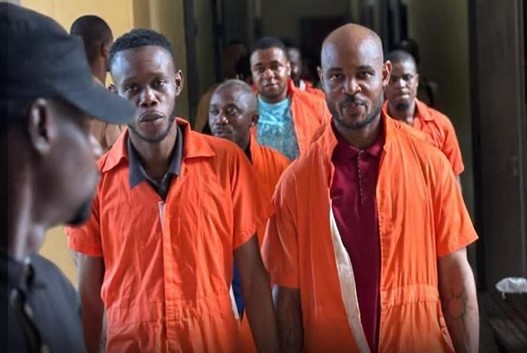
PHOTO: Some of the defendants in the ongoing Capitol Arson case
By Garmah Never Lomo, garmahlomo@gmail.com
TEMPLE OF JUSTICE, Monrovia- Liberian Police Chief Investigator of the Crime Services Department, Reafeal Wilson continued his testimony on Tuesda,y December 16,2025 during the cross-examination in the ongoing Capitol Building arson trial.
But questions were raised about the credibility and validity of the fire investigation and audio evidence presented by the state.
At the cross-examination, one of defense lawyers Cllr Arthur T. Johnson questioned Wilson about the identity of an international fire expert who reportedly assisted the Liberia National Fire Service (LNFS) during the investigation.
In response, Wilson told the court he could not recall the expert’s name, neither the name of the institution the international fire expert represented a statement that appeared to surprise the court.
Continuing the cross examination, defense further questioned Wilson about findings made during the investigation with the assistance of the international expert, asking what conclusions were communicated to him.
The prosecution objected, arguing that Wilson was not the best source to testify on expert findings and that the state intended to call the expert to testify directly. Judge Roosevelt Willie sustained the objection.
Following the above question, tensions arose when the prosecution requested the court to disallow reference to an international fire expert’s report introduced by the defense. The defense countered that the report highlighted serious flaws in the LNFS investigation, including misstatements, inaccuracies, and conclusions unsupported by modern fire science or best investigative practices.
However, portions of said report was read in court, the LNFS report lacked critical details, including the names of responding personnel and descriptions of specific actions taken at the fire scene. The report stated that, given the scale of the fire, the LNFS report should have been comprehensive, but “unfortunately, this is not the case.”
Defense lawyer Cllr. Arthur T. Johnson further cited the report as stating that the Liberia National Fire Service lacked the training, experience, and equipment to properly collect, preserve, or store evidence. The report also noted that the fire scene was not adequately examined and criticized the Liberia National Police for insufficient documentation regarding personnel and investigative actions at the scene.
The prosecution argued that the defense was introducing “strange practices” into the proceedings. The defense rejected the claim, maintaining that cross-examination is intended to uncover the truth.
Attention later shifted to an audio recording allegedly linked to defendant Dixon Seboe. Defense counsel questioned Wilson about the identity of voices in the recording, asking whether he could confirm that the voice belonged to Seboe. Wilson acknowledged that he is not a voice expert and that the audio did not clearly identify the speaker as Dixon Seboe, noting that the individual referred to himself only as “Seboe.”
Wilson testified that the National Security Agency (NSA) assisted the police by providing technical support and analyzing the audio recording. He said investigators listened to the recording and concluded it implicated Dixon Seboe.
However, the defense pressed Wilson on the absence of a formal voice analysis report and the lack of testimony from a qualified voice expert.
“You told the court you are not a voice expert,” defense counsel argued. “How then did you determine it was Dixon’s voice?”
Wilson responded that a voice expert would be produced to testify and explain the findings.
The defense also questioned Wilson about his interrogation of Dixon Seboe, noting that Seboe denied any involvement in the alleged Capitol attack and claimed he learned of the fire after waking up. According to the defense, Seboe stated that he later went to the Capitol Building after other government officials had already arrived.
Wilson confirmed that Seboe provided information denying involvement and that no force was used to obtain the statement. He also acknowledged that his investigative report reflected these facts.
The trial continues as the court weighs challenges to the credibility of the fire investigation, expert testimony, and audio evidence presented by the prosecution.