
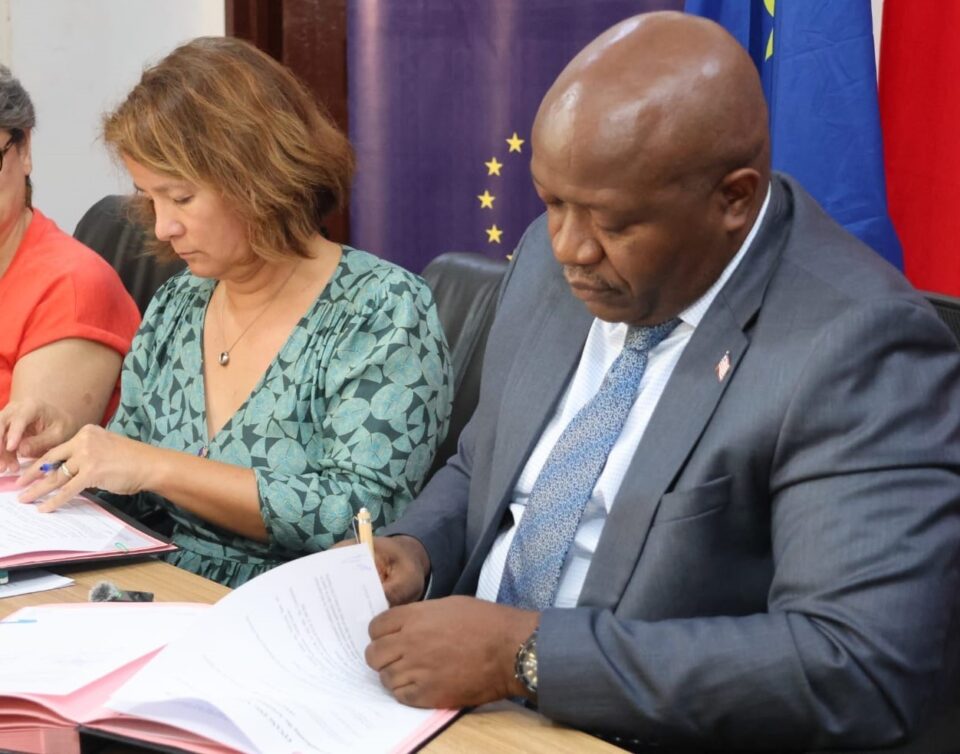
PHOTO: EU’s Ambassador Nona Deprez and Liberian Finance Min. Augustine Ngafuan signing the agreement
The Liberian government and the European Union have signed a US$29.5 million grant financing agreement to strengthen the artisanal fisheries value chain, improve livelihoods, and enhance food security across Liberia’s nine coastal counties.
Finance and Development Planning Minister Augustine Ngafuan signed the agreement on behalf of the Liberian government and the EU Ambassador, Nona Deprez penned the agreement on behalf of the European Union.
Speaking at the ceremony, Finance and Development Planning Minister Augustine Kpehe Ngafuan described the agreement as further proof of the EU’s long-standing and reliable partnership with Liberia, particularly during difficult economic periods.
He recalled the EU’s timely budget support in 2024, noting that Liberia met agreed performance targets, paving the way for continued cooperation.
The Finance Minister described the agreement as further proof of the EU’s long-standing and reliable partnership with Liberia, particularly during difficult economic periods.
He recalled the EU’s timely budget support in 2024, noting that Liberia met agreed performance targets, paving the way for continued cooperation.
Minister Ngafuan emphasized that the fisheries project is grant-based, not a loan, and directly addresses livelihoods by empowering Liberians within the sector. “This is not about bringing cartons of fish,” he said. “You have come to help us fish for ourselves.”
For her part, EU Ambassador Nona Deprez, reaffirmed the EU’s commitment to Liberia’s artisanal fishing communities, stating that the project aligns with Liberia’s ARREST Agenda, national fisheries policies, and the EU’s Global Gateway strategy.
She highlighted the importance of fisheries for livelihoods, nutrition, and economic resilience along Liberia’s 600-kilometer coastline.
Also speaking, the Acting Director General of the National Fisheries and Aquaculture Authority (NaFAA), J. Cyrus Saygbe , described the agreement as a milestone for inclusive growth and sustainable fisheries development.
He noted complementary reforms, including a 25 percent reduction in canoe licensing fees, market access initiatives, and strengthened efforts to combat illegal, unreported, and unregulated fishing in collaboration with the Liberia Coast Guard.
The project will support artisanal fishers and fishmongers through improved cold storage, ice-making facilities, fish handling infrastructure, job creation, and reduced post-harvest losses. These interventions are expected to raise incomes, strengthen food security, and improve household welfare in coastal communities.
The agreement also supports institutional and human capacity development, including fisheries training at the University of Liberia, Tubman University, and community colleges, as well as NaFAA’s decentralization plan to bring services closer to fishing communities.
Both sides stressed that the success of the initiative will be measured by tangible improvements in the lives of Liberians, particularly those in coastal areas policies, and the EU’s Global Gateway strategy.