
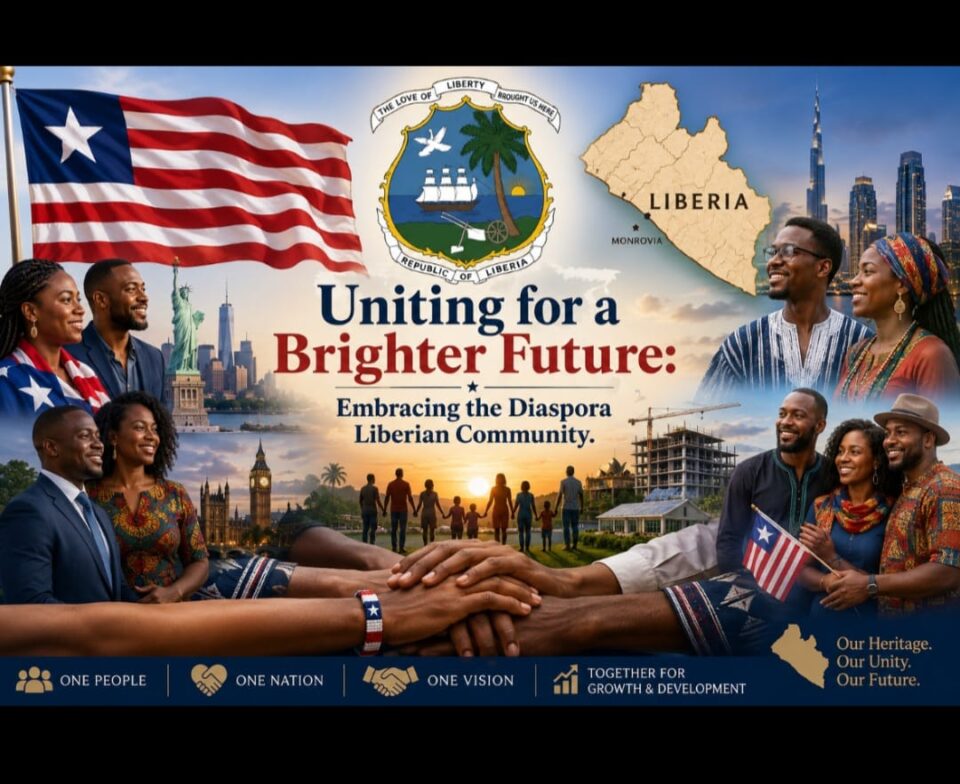
By Austin S. Fallah – A True Son of the Planet Earth Soil: fallahas@yahoo.com
“Let this July 26, 2026, kindle a different meaning in the thoughts of Liberians as a people with one voice of national unity for social and economic development and shifting minds for the common good.” Austin S Fallah.
Voices from across Liberia’s history reflect a deep consensus: bridging divides and embracing the diaspora and the homeland is the foundation of the country’s sustainable development and healing.
Leaders, artists, ordinary Liberians, and public figures capture the spirit of national unity and collective progress.
President Joseph Nyuma Boakai: “Though the accident of our births has made of us a diverse people, we must employ our Liberian citizenship to make of us a united people, for only a united people can build a nation. I embrace all my fellow Liberians at home and in the diaspora.”
Former President Ellen Johnson Sirleaf: “We are committed, as a people, to build a new Liberia from the ashes of an old, turbulent, and tragic past to a future of hope and promise. Let us resolve that our pride in our Liberian nation, and in our tradition and heritage, will be manifested in a new commitment to the democratic processes.”
Former President George Manweh Weah: “A love that will bring back home Liberians scattered far and wide across the globe, many of them highly skilled, talented, and experienced, to join us in building a New Liberia. The unity, strength, and identity of our nation are not found in bricks and mortar. They live in the hearts, minds, and fighting spirit of our people everywhere.”
Ambassador Dr. Al-Hassan Conteh (Liberian Ambassador to the U.S.): “To my fellow Liberians in the United States, Canada, and Mexico, I encourage you to remain committed to being ambassadors for our great nation. Let us foster cultural exchanges and support development initiatives that benefit our homeland.”
General Public / Civic Leaders (National Unification Day Consensus): “No matter which political side you belong to, let us always build bridges to unite us rather than walls to divide us. We were born as Liberians before we became partisans of political parties.”
Liberian Proverb: “A single straw of a broom can be broken easily, but the straws together are not easily broken.”
Leymah Gbowee (Nobel Peace Prize Laureate / Novelist): “You can tell people of the need to struggle, but when the powerless start to see that they really can make a difference, nothing can quench the fire.”
Sheikh Kouyateh (Civil Society Leader): “Let us embrace our diversity and celebrate our common humanity, for it is in unity that we find strength. Let us work together to build a future where every Liberian can thrive, where opportunities abound for all.”
The concept of diaspora often evokes a dual sentiment.
For some, it fosters a sense of pride in the cultural and intellectual achievements of those who have migrated from their homeland.
For others, it elicits suspicion and xenophobia, leading to a divisive narrative that pits members of the Diaspora against their compatriots who remain in their ancestral homeland.
In the case of Liberia, the lingering scars of a devastating civil conflict have exacerbated this divide, leading to an unjust narrative that paints returnees from the diaspora as outsiders or foes.
However, this perspective is not only misguided but detrimental to the country’s social and economic progress.
Diaspora Liberians should be viewed as brothers and sisters who, amid adversity, have enriched their own lives and Liberia’s intellectual standing.
It is time for Liberians at home to embrace their returning compatriots, opening their hearts and minds rather than feeding into the negativity of gossip and suspicion.
Historically, Liberia has experienced tumultuous periods that have forced many of its citizens to seek refuge abroad.
The civil conflict that erupted in the late 20th century resulted in countless Liberians fleeing for safety, some by choice and others by circumstance.
Far from stifling the intellectual aspirations of these individuals, their time abroad has often served as an incubator for talent and resilience.
Today, many have acquired advanced degrees, specialized skills, and invaluable experiences that can contribute significantly to Liberia’s development.
The educational opportunities available in developed countries often surpass those accessible within Liberia’s university system.
While some may view the exit of these educated individuals as a brain drain, it is essential to recognize it instead as a brain gain, a transfer of skills and knowledge that can propel Liberia towards a more prosperous future.
The reality is that many Diaspora Liberians have become successful leaders and professionals whose achievements are celebrated globally.
They occupy positions in business, academia, information technology, social work, human services, human resources, law, software systems engineering, public policy, public administration, medicine, and electrical and mechanical engineering, to name a few.
For instance, several prominent Liberian professionals hold positions at prestigious universities, governments, and corporations, where they sharpen their skills and foster networks that can benefit Liberia if leveraged correctly upon their return.
Their presence can enhance Liberia’s intellectual capital and establish the country as a player in the global arena.
Contrary to outdated narratives, the diaspora experience need not be seen as a departure from national identity.
Instead, it represents an expansion of perspectives.
Diaspora Liberians are often exposed to diverse cultures and innovative ideas, which they can bring back home to contribute to societal growth.
This cultural exchange can catalyze significant advances in policy-making, education reform, and economic development.
Rather than approaching returnees with suspicion, asking, “When are you going back?”, Liberians at home should engage them in meaningful dialogue about how their experiences can elevate the nation.
The fear that some Liberians harbor towards their returnee brothers and sisters often stems from a lack of understanding about their journeys and sacrifices.
It is crucial to dispel the myth that all returnees fled due to criminal behavior or inadequacy.
Many left in search of opportunities systematically denied to them in their own country.
In recognizing this, it becomes apparent that returning diaspora members bring not just their ideals and aspirations, but also their commitment to bettering the lives of their fellow citizens.
They are keen to share the knowledge and skills acquired abroad rather than foster divisions based on where one has lived.
Furthermore, integrating returning Liberians into society can build a more vibrant community, enhancing the nation’s social fabric.
The homecoming of the diaspora should be celebrated as a triumph over adversity, a testament to the resilience of the Liberian spirit.
When individuals re-enter their homeland after years abroad, they should be welcomed and celebrated, not scrutinized.
This collective celebration can inspire others in the diaspora community, igniting discussions that fuel future collaborations with the local population.
Instead of clinging to prejudices and negative assumptions, it would be beneficial for Liberia to foster an inclusive environment that embraces the diverse backgrounds of all its citizens, those who remained and those who returned.
This inclusivity can promote national unity and generate fresh ideas and pathways toward economic development.
Liberian society has so much to gain by channeling the collective strength of its people, including those who have gone through the diaspora transition.
The curious case of cross-border trade illustrates how the diaspora can foster economic development.
Many diaspora Liberians who return have established businesses or partnerships with existing local enterprises.
They often possess a wealth of know-how regarding international market standards, logistics, and the critical infrastructure needed for success.
This collaborative spirit fuels economic growth, creates jobs, and empowers local communities.
It dismantles harmful stereotypes and builds a narrative centered around collective progress.
In instances where the diaspora community has experienced discrimination or isolation upon returning, it can lead to a deterioration of the spirit of collaboration and shared identity that should define Liberia.
Such sentiments can foster resentment between locals and returnees, creating roadblocks to potential growth and development.
However, educational initiatives aimed at bridging gaps in understanding can help shift these mindsets.
National and community programs that promote cultural exchange, professionalism, and shared vision can unite the population.
Moreover, the emergence of digital platforms that connect Liberians worldwide, such as social media and professional networks, can further facilitate the exchange of ideas.
Digital platforms have made it easier than ever to collaborate on social and economic projects, transcending geographical boundaries.
They provide opportunities for those with diverse experiences to come together and strategize on common challenges and solutions, reinforcing community standing.
The enmity often directed at returning Liberian diaspora members tragically contradicts the need for unity in addressing the myriad conflicts and challenges confronting Liberia.
Access to education, healthcare, and infrastructure remains an uphill battle.
However, the synergy that can result from open arms toward returning Liberians can transform the landscape altogether.
Acknowledging the potential contributions of those who have gone abroad will align all Liberians’ efforts to tackle these pressing issues collectively.
Thus, embracing diaspora Liberians requires dismantling the often paradoxical narrative that has hindered progress.
Rather than fixating on the superficial distinctions that divide, be it place of residence, educational attainment, or socioeconomic status, Liberians at home must rally under a shared identity.
This unity reinforces the idea that every citizen, regardless of their journey, plays a pivotal role in the country’s growth.
The plight of Diaspora Liberians and their eventual return home should be viewed through the lens of kinship and collaboration.
We must recognize the richness that their experiences bring to the nation, promoting a narrative of inclusion and hope rather than division.
As Liberia embarks on a journey of healing and rebuilding post-conflict, it becomes paramount that all citizens, regardless of their location, come together in solidarity to forge a brighter future.
It is time to see the returning hearts as defenders of Liberia’s collective dreams, partners in their ambition to uplift Liberia, and most importantly, as siblings in the pursuit of social and economic progress for the common good.
Only together can Liberians truly advance Liberia on its path towards prosperity and unity.