
PUL Prexy Kanubah Says This Is No Longer An Option
By Alfred Kollie, alfredkolliejr92@gmail.com
Monrovia, Liberia – The Press Union of Liberia (PUL) has joined national stakeholders in calling for the urgent establishment and operationalization of Liberia’s Specialized National Anti-Corruption Court, describing it as critical to strengthening democratic governance and national development.
Speaking this week (Tuesday, July 1, 2026) as a panelist at the National Anti-Corruption Policy Dialogue in Monrovia, PUL President Julius Kanubah stressed that the creation of the court is no longer optional but a consequential necessity for Liberia’s future.
“The Press Union of Liberia calls on President Joseph Nyuma Boakai, House Speaker Richard Koon, Senate Pro Tempore Nyonblee Karnga Lawrence, the Chief Justice and Associate Justices of the Supreme Court, and all branches of government to make the establishment of the National Anti-Corruption Court their collective legacy,” Kanubah declared.
He warned that any attempt to delay the court’s creation would amount to a betrayal of future generations, emphasizing that corruption has for decades reversed development gains, deepened poverty, weakened human security, and undermined the rule of law.
Reflecting on Liberia’s history, the head of Liberia’s Press Union noted that corruption played a major role in fueling the country’s civil conflict, eroding public confidence in government, and contributing to political instability.
While commending the Government of Liberia under President Boakai for recent actions, including the suspension, dismissal, and prosecution of public officials accused of corruption, Kanubah said the pace of reform remains slow and requires stronger institutional backing.
He cautioned that if the court is not established and fully operational by December 2026, political interests ahead of the 2029 elections could derail the process.
In May 2026, President Boakai submitted a bill to the Legislature seeking the creation of the Specialized National Anti-Corruption Court, following nationwide consultations spearheaded by the Office for the Establishment of War and Economic Crimes Court in Liberia.
According to Kanubah, the court would play a key role in guaranteeing effective prosecution of corruption cases, restoring public trust in governance, and safeguarding public resources to support sustainable national development.
Drawing on former President Ellen Johnson Sirleaf’s famous description of corruption as a “vampire,” Kanubah said the specialized court must serve as Liberia’s “anti-corruption vampire” by draining corruption of its lifeblood and ending impunity in public institutions.
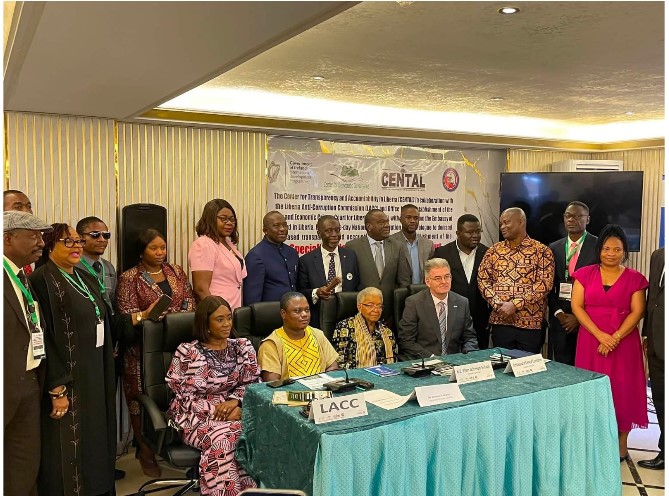
The National Anti-Corruption Policy Dialogue was organized by Center for Transparency and Accountability in Liberia in partnership with the Liberia Anti-Corruption Commission and OWECC-L, with support from the Embassy of Ireland in Liberia.
Held at the Boulevard Palace in Sinkor, the event brought together several key national and international stakeholders, including former President Ellen Johnson Sirleaf, Ambassador Gerard Considine, Cllr. Dr. Jallah Barbu, Cllr. Tiawan Gongloe, Cllr. Alexandra Zoe, Christian Mukosa of the UN Office for Human Rights, Lawrence Yealue of the National Civil Society Council of Liberia, Cllr. Bendu Kpoto of AFELL, Matthew Kollie of the Governance Commission, and Madam Lorpu Page of the Independent Information Commission.
The dialogue forms part of ongoing national efforts to strengthen accountability mechanisms and intensify Liberia’s fight against corruption.