
This manifesto was not written to provoke outrage, but to end a long silence.
PREFACE
This manifesto was not written to provoke outrage, but to end a long silence.
For more than two centuries, Liberia has been described through comforting myths—of freedom, benevolence, and independence—while the legal and historical record tells a different story. Behind the language of liberty lies a system of racial engineering, sustained by law, enforced by power, and protected by deception.
America is not free because America is living a life of deception and lies. A nation cannot claim liberty while refusing to confront the injustices embedded in its own laws, policies, and institutions.
The Free Liberia Movement begins with a simple premise: no nation can heal without truth.
This document traces a continuous line—from the earliest American laws legalizing slavery and criminalizing Black literacy, to the First Nationality Act of 1790, to the forced colonization of U.S. citizens in Liberia, and to the modern persistence of racialized citizenship and mobility. What is often treated as disconnected history is, in fact, a single, coherent system whose consequences remain unresolved.
Liberia was not created by a people seeking separation from the United States. It was created by a government seeking separation from them—from Black citizens who claimed equality, literacy, land, and law. Colonization was not an act of charity; it was a legal strategy designed to preserve white supremacy while avoiding constitutional reckoning.
This manifesto does not deny Liberia’s culture, resilience, or achievements. It honors them. But it insists that dignity without rights is not freedom, and independence without lawful repair is not sovereignty.
The questions raised here are not only Liberian questions. They are American questions. They ask whether a nation founded on equality can continue to deny citizenship, mobility, and repair to those it once colonized. They ask whether democracy can survive when its foundational injustices are buried rather than confronted.
The Free Liberia Movement does not seek revenge. It seeks reckoning, restoration, and reconciliation—through law, truth, and nonviolent action. It calls upon Congress, courts, churches, scholars, and citizens to confront an unfinished chapter of history and to complete the work that justice demands.
This is not a call to divide.
It is a call to repair what was broken before unity is possible.
Only truth can make us free.
AUTHOR’S NOTE
I write this manifesto not as a spectator of history, but as one of its consequences.
I am a descendant of people who lived in dignity before colonizers and enslavers arrived from Europe and
America. I am a citizen of the only country on Earth envisioned, designed and created by citizens of the
Government of the Unitred States for citizens of color who were legally recognized as citizens of the United States, yet were removed, exiled, and abandoned through policies designed to preserve racial hierarchy while avoiding constitutional accountability. The questions raised in this work are therefore not abstract. They are lived, inherited, and unresolved.
This manifesto is grounded in law, historical record, and primary sources—including statutes, court decisions, congressional acts, treaties, petitions, and archival documents. Where interpretation is offered, it is clearly distinguished from fact. Where claims are made, they are tied to evidence. This work does not rely on rumor, mythology, or grievance alone. It relies on the public record.
Some readers may find these conclusions uncomfortable. That discomfort is not accidental. History that threatens no one’s conscience is usually incomplete. The purpose of this manifesto is not to shame, but to clarify; not to accuse individuals, but to hold systems accountable.
This work does not deny the agency, resilience, or achievements of Liberians or Americans. It affirms them. But it refuses to confuse survival with justice, or independence with sovereignty, or dignity with equality under law.
I anticipate that some will attempt to dismiss this work as radical, divisive, or revisionist. Such labels have often been applied to every serious challenge to entrenched injustice—from the abolition of slavery, to women’s suffrage, to civil rights. The true measure of this manifesto is not whether it is comfortable, but whether it is true.
This is not a call for revenge. It is a call for reckoning, repair, and reconciliation—through lawful, nonviolent, and democratic means. It is written in the belief that democracy does not collapse when truth is told; it collapses when truth is suppressed.
If this work succeeds, it will not do so because it flatters the present, but because it completes an unfinished moral and legal project. The future we claim depends on the history we are willing to face.
— Rev. Torli H. Krua
Founder, The Free Liberia Movement
Founder, Universal Human Rights International (UHRI)
Boston, Massachusetts, USA
THE FREE LIBERIA MOVEMENT
MANIFESTO & FOURTH REMONSTRANCE
Truth • Justice • Citizenship • Rebirth
Restoring the Promise Betrayed — 1641 to 2025
PREAMBLE
For two centuries, the Liberian people have lived inside a contradiction — a nation called the “Land of Liberty” built on a foundation of nearly four centuries of deception. Liberia’s name, motto, and institutions were not created by free people seeking self-determination, but by enslavers, politicians, and racial engineers who designed the country to serve their interests, not ours.¹
The Free Liberia Movement exists to expose the truth, confront the legacy of colonization, restore citizenship rights stolen through deception, and lead our people into a new era of justice, equality, and national rebirth. Our movement aims to heal the deeply divided “United” States of America and prevent the impending catasthropic collapse destined to cripple the whole world. Alas, “United we stand. Divided we fall.” “A nation divided against itself cannot stand.”
I. THE ORIGIN OF THE DECEPTION
1. The Body of Liberties and the American Roots of Oppression
Liberia’s story begins in Massachusetts.
White supremacists and enslavers sought to make the crime of slavery permanent. To sustain oppression, they relied not only on force, but on deception—redefining injustice as virtue and disguising bondage as “liberty.” Colonization became the method by which slavery and racial control were preserved under the language of freedom.
In 1641, the Massachusetts Bay Colony adopted the Body of Liberties, the first legal code in North
America to explicitly authorize slavery.² Instead of calling a spade-a spade, Slavery became “Liberty”.
In 1670, colonial amendments entrenched hereditary enslavement by law, binding the status of unborn children to the condition of their mothers.³
These laws formed the ideological and legal foundation of American racial policy, including the federal government’s colonization of U.S. citizens in Liberia as a response to Black freedom and demands for reparations.
In 2025, this deception is not confined to Liberia. It persists across many so-called “independent” former colonies where colonial powers fought wars, lost control, yet never confessed their crimes, never repented, never paid reparations, and never reconciled with the peoples they oppressed for centuries.
France, for example, forced Haiti and other colonies to pay reparations to former enslavers for their alleged losses, while slavery itself—a crime against humanity—and the system of colonization that sustained it remain largely unacknowledged and unrepaired.
2. The First Birthright Citizenship Ruling (1781–1783)
In Brom & Bett v. Ashley (1781), Elizabeth “Mum Bett” Freeman successfully sued for her freedom under the Massachusetts Constitution, establishing that all persons born free and equal were citizens by right, regardless of race.⁴
Chief Justice William Cushing instructed the jury that slavery was incompatible with the Constitution of Massachusetts.⁵
This ruling abolished slavery in Massachusetts and established birthright citizenship for Black Americans decades before the Fourteenth Amendment, a precedent binding on descendants and applicable to African Americans later exiled to Liberia.
II. THE CREATION OF LIBERIA: A U.S. COLONY, NOT AN INDEPENDENT NATION
1. The Slave Trade Act of 1819
A Congress dominated by enslavers enacted the Act of March 3, 1819, authorizing the President to suppress the transatlantic slave trade and to remove captured Africans and others to settlements outside the United States.⁶
President James Monroe—himself an enslaver—misused this authority, deploying the
U.S. Navy and establishing what became known as the United States Agency for Liberated
Africans. Using taxpayer funds and military force, the federal government acquired land in
West Africa for the settlement of “citizens of the United States of America forever.”
Attorney General William Wirt, in Opinion No. 229, explicitly warned that the Act could not lawfully be used to deport U.S. citizens, underscoring clear constitutional limits on executive power.⁷
Despite this warning, thousands of Black American citizens were removed, coerced, or pressured into relocation and settlement in Liberia over the course of more than a century, while Jim Crow laws simultaneously ravaged the lives of African Americans who remained in the United States.
2. The American Colonization Society Was Never Sovereign
After the First Nationality Act codified racial apartheid as federal law, the American Colonization Society (ACS) was formed in 1816 by slaveholders, politicians, judges, and elite supporters of racial separation. The organization initially operated without a state charter or legal incorporation, yet actively promoted the removal and colonization of African American citizens outside the United States.⁸
At the time Liberia was founded in 1822 through direct action of the U.S. Government, the ACS was not a legally constituted entity. It possessed no sovereign authority and no lawful capacity to acquire territory, govern people, or create a nation.
Only after settlers in Monrovia began questioning the ACS’s authority and demanding recognition of their rights as U.S. citizens—particularly in 1831 and 1837—did the
State of Maryland grant the ACS a charter, legalizing the organization long after Liberia had already been established..
In 1844, the U.S. House Committee on Foreign Affairs declared the ACS charters “null and void,” with no authority to exercise sovereignty, acquire territory, or establish a nation.⁹ A corporation declared null and void cannot lawfully:
- Own sovereign territory
- Transfer sovereignty
- Declare independence
- Create a nation under international law
3. 1821–1822: U.S. Naval Seizure of Liberian Territory
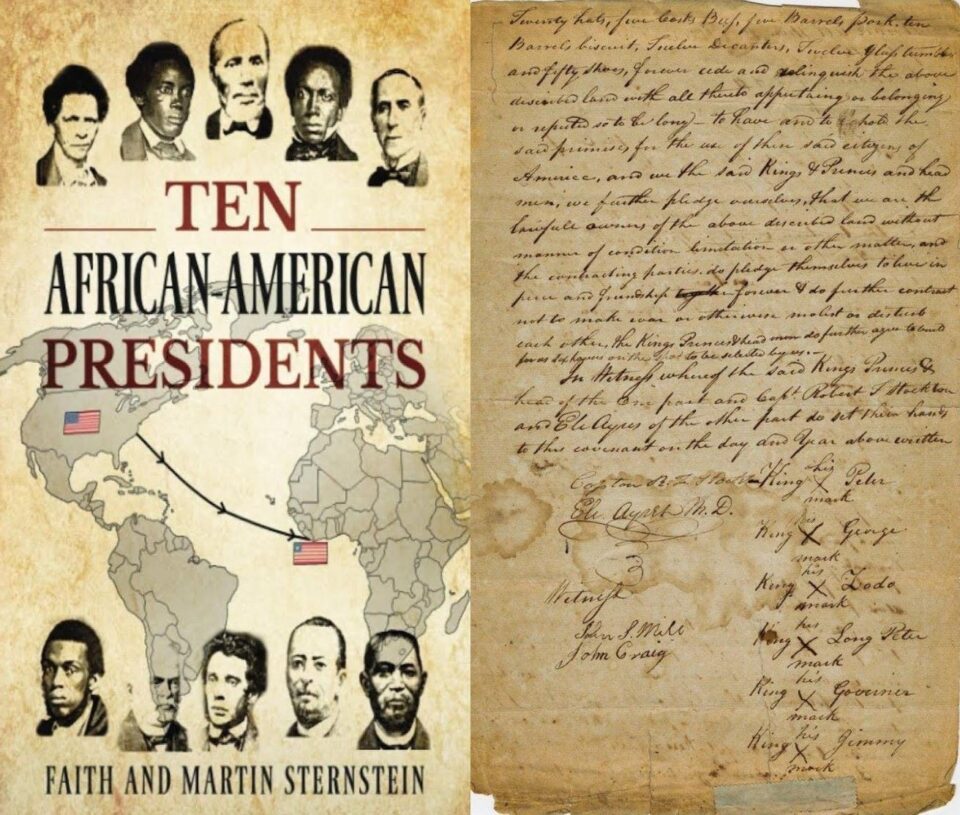
U.S. Navy Lieutenant Robert F. Stockton, acting under presidential authority, coerced coastal leaders including King Long Peter into ceding land under threat of force.¹⁰
Stockton reported that the land was acquired for the *“settlement of citizens of the United States forever.”*¹¹
On April 25, 1822, the U.S. flag was raised at Cape Mesurado, accompanied by naval gun salutes marking formal occupation.¹²
Under international law, this constituted territorial acquisition by a sovereign state, the Government of the United States of America, not private colonization.