
By Austin S. Fallah – A True Son of the Planet Earth Soil: fallahas@yahoo.com
Rev. Dr. Myles Munroe: “Build a routine so strong that success has no choice.”
“Success does not come from adding more, but removing excess.”
“You can not ask God to increase your territory when your current territory is unmanaged.”
“Vision gives you focus, and vision gives you structure.”
A fundamental tenet of democratic governance is accountability.
In the realm of public service, government officials, including elected and appointed leaders, are entrusted with responsibilities that profoundly affect their constituents’ lives.
Therefore, it is not only the right but also the duty of the public to question these officials when they fail to uphold their responsibilities.
This right to question and demand accountability is enshrined in the very fabric of democratic societies.
Even revered figures in history and religion, such as Yeshua Christ, were not immune to moments of questioning and doubt.
Yeshua Christ’s heart-wrenching inquiry from the cross, “Eloi, Eloi, lema sabachthani?”, which translates to “My God, my God, why have you forsaken me?”, exemplifies the human experience of seeking understanding, even in the face of deep suffering.
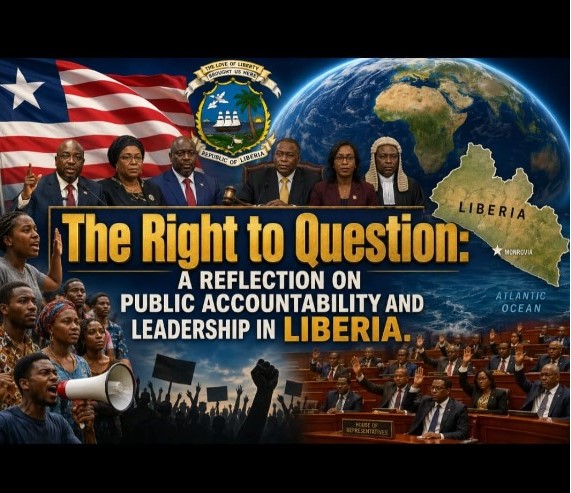
In this essay, I will argue that not only should the public have the right to question their leaders, but such scrutiny is essential for the very health of the democratic process, particularly in Liberia.
The Right to Question Public Officials:
In a democratic context, questioning public officials is an act of participation. Public officials, elected by the electorate, are not above scrutiny.
They are servants of the people, tasked with executing policies, ensuring justice, and representing the interests of the populace.
When these officials fail to meet these mandates, it is the public’s duty to hold them accountable.
The very foundation of democracy relies on the active engagement of its citizens, who must be vigilant in questioning and evaluating their leaders’ actions.
In Liberia, the accountability of elected officials has been tested artfully through history.
For instance, during the tumultuous reigns of Presidents Samuel K Doe and Charles Taylor, the public’s demand for transparency and integrity was evident.
Many Liberians stood against their administration’s rampant corruption and human rights violations, demonstrating that questioning authority is not merely a right but a necessity for preserving democracy.
The collective efforts of civil society organizations, humanitarian groups, and the populace at large invoked a spirit of resilience that eventually led to the ousting of Samuel K. Doe, NDPL, and Charles G. Taylor, NPP.
The courage to question, criticize, and hold leaders accountable fostered a shift towards a more hopeful future for Liberia.
Moreover, the question of whether public officials are above scrutiny applies not only to the negative outcomes of their leadership but also to the evaluation of their character and integrity.
In the same vein, the intricate relationships between power and accountability warrant scrutiny, as illustrated in the inquiries surrounding the administration of Ellen Johnson Sirleaf, Liberia’s first female president.
While her presidency was marked by many significant achievements, such as receiving the Nobel Peace Prize for her efforts to ensure peace and rebuild the country, her administration also faced accusations of a lack of transparency in certain governance contracts.
Rather than silencing the critics, the public’s questioning sparked more robust discussions about accountability among high-ranking leaders.
Responsibility and Respect in Questioning:
While the right to question is paramount, it must be exercised responsibly and respectfully.
The manner in which questions are posed significantly determines the nature and outcome of the dialogue between the public and their officials.
Outrageous accusations, unsupported by evidence, can lead to unnecessary conflict and undermine the very civil discourse essential to a functional democracy.
Thus, the expectation is to engage in respectful questioning that fosters understanding rather than division.
Moreover, the role of a well-informed public cannot be overstated.
Educational initiatives that empower citizens with knowledge of their rights and their leaders’ responsibilities create a more sophisticated populace that can engage meaningfully in discussions.
In Liberia, organizations that conduct civic education programs empower citizens to voice their concerns while underscoring the importance of facing their leaders directly.
Such initiatives promote an environment where the public feels confident in questioning officials and demanding accountability without resorting to hostility.
In addition to fostering respect, officials must foster an atmosphere receptive to questioning. Public figures should embrace scrutiny rather than fear it.
By demonstrating accountability, government officials can cultivate trust and regional stability, which, in turn, lead to increased investment and economic growth.
When officials leave their positions, whether through elections or other means, they must remember that their legacy will rely heavily on how they responded to public questioning.
Leaders like William Tubman, who reigned for 27 years, garnered both admiration and criticism in debates throughout his tenure.
His policies, followed by the extensive questioning from the opposition, highlighted a vibrant public engagement that ultimately shaped Liberia’s political landscape.
Great Leaders are Open to Scrutiny:
Great leaders, regardless of their status, remain open to questions and challenges.
Not only do they acknowledge their fallibility as human beings, but they also demonstrate a willingness to listen and evolve.
This principle is deeply embedded in various historical contexts.
For example, Mahatma Gandhi, whose profound teachings have transcended borders, advocated for a government accountable to the will of the people.
His philosophy of non-violence and truth resonated with citizens worldwide and represents an ideal for all leaders, including Liberian officials, to strive towards.
Public questioning often leads to revelations about policy failures, the need for reform, and the potential for positive changes that ultimately serve the populace better.
When constituents ask for clarification or call out injustices, they participate in a dialogue that enhances the social contract between the governed and those in power.
Utilization of technology and media in modern governance further amplifies this discourse. However, the public needs to use these platforms responsibly.
Misinformation, sensationalism, and public shaming, when used irresponsibly, can distort the nature of the question and detract from constructive governance.
Biblical and Leadership Figures: A Comparative Analysis:
In addition to Yeshua Christ, numerous religious figures throughout history have been known for examining leadership and moral authority.
In the Bible, for instance, Job fervently questioned God about his suffering, asserting his innocence while seeking answers.
This biblical narrative emphasizes that questioning transcends mere figurative language; it is a human impulse shaped by the pursuit of justice and truth.
Similarly, Liberian history is rich with examples of leaders who have faced scrutiny and answered for their actions.
Notably, J.J. Roberts, Liberia’s first president, was questioned about his policies in addressing the needs of the indigenous populace, sparking debates about inclusiveness and equitable governance.
Leaders in Liberia and elsewhere who are willing to engage with their constituents openly demonstrate strength and commitment to public service.
Such interactions can transform distrust into collaboration, motivating citizens to contribute positively to their communities, whereas officials who resist questioning risk isolation and growing resentment from the people they serve.
The Path Forward for Liberia:
The discourse surrounding the questioning of government officials is vital to the health of any democracy, particularly in a post-conflict nation like Liberia.
There must be an acknowledgment that public scrutiny is not only a right but also an essential function of democracy, fostering accountability, transparency, and ultimately progress.
As citizens question their leaders’ actions and character, they honor the democratic process while ensuring that their government remains in service of the people.
Just as the narratives of Yeshua Christ and other historical figures have shown humanity that questioning is part of growth, so must the citizens of Liberia use their right to question resolutely and respectfully.
As Liberia forges ahead, it is critical to cultivate an environment where questioning is not only accepted but celebrated. Public officials must be reminded of their place as servants of the people, whose actions are subject to scrutiny to maintain the integrity of their positions.
Through mutual respect, responsible questioning, and active civic engagement, Liberians can ensure that their democracy flourishes.
In essence, accountability is not merely the obligation of officials but a shared responsibility among all citizens, undoubtedly the path forward for a strong and vibrant Liberia.