
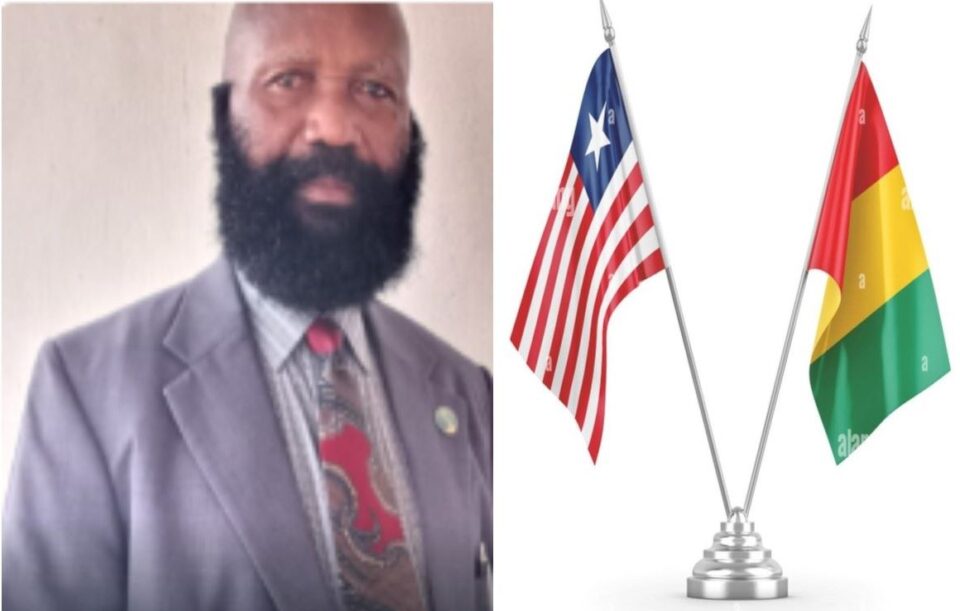
PHOTO: The Author, Pero Kerkula
The writer is an instructor of Public Administration at the University of Liberia.
The Guinea-Liberia border crisis is a resolvable incident that can be settled through negotiation, mediation, or international arbitration. Of course, there exists no intractable conflicts between the two sisterly countries centered on identity, land or deep-seated historical grievances.
This border crisis involves interests that allow for win-win outcomes or reasonable compromise. We cannot and will not afford Guinea-Liberia pre-independence and post-independence relationships to be eroded. Liberia played significant roles towards Guinea’s independence and sovereign rule. Let it be told for reasoning minds to think and rethink regional brotherhood and African solidarity both countries support.
The Guinea-Liberia border crisis is more of a responsible back-channel diplomatic discussions than a negative oppoisition political outcry. The Makona River area is a great cross-border point and has been so since 1958 till now between Guinea and Liberia (Foya District) local administration border check point.
Guinea gained its independence on 2nd October, 1958 from French colonial rule. France, in relation for Guinea’s independence and sovereign rule, uprooted every infrastructural development from Conakry and Guinea. The new country – Guinea solely depended on the Republic of Liberia for expanding its – economic integration and usage of Liberia’s Freeport for exports and imports of goods around the globe.During Guinea’s declaration to vote “No” to the French rule in September of 1958 – led to severe economic retaliation from France. Liberia’s President William V.S. Tubman played significant roles, rather than a single publicized statement.
For the most part, President Tubman realizing the important roles played by Liberia in Guinea’s independence for self-rule, decided to honor and respect the territorial integrity and sovereignty of Guinea by recognizing the colonial demarcated border that gave birth to Guinea’s independence.
Even though the French colonialists are said to have reportedly urged Liberia to reclaim its border territory that had been annexed to French Guinea, President Tubman in his wisdom declined. He prioritized regional and African solidarity and the Government of Liberia accepted the standing colonial border demarcation of 1958.
French colonialists imposed economic blockade on a new country – Guinea. The Government of Liberia granted open access to the Freeport of Monrovia to the usage of Guinea to counter the economic blockade that was imposed on Guinea by France. A high-level Liberian delegation headed by President Tubman attended Guinea’s independence.
President Tubman granted access to the Freeport of Monrovia to Guinea to import essential goods, including but not limited to petroleum products, a move that was seen as critical to securing economic growth and development for Guinea. President Tubman attended the independence ceremonies in 1958 to show support for President Ahmed Sékou Touré and Guinea a new country in the region. Guinea became the second independent nation in West Africa (and sub-Saharan Africa) on 2nd October, 1958 after Ghana’s independence on 6th March, 1957.
*The Makona River border crisis*
On 2nd March, 2026 armed Guinean soldiers crossed into Liberia by and through Makona River crossing point and encroached on Liberian territory in Foya District, Lofa County. Of course, commencing repeated incursions into Foya District, Lofa County, over a territorial dispute near the Makona River called for an emergency meeting that was held in Conakry, Guinea. Liberia and Sierra Leone are founding members of the Mano River Union – MRU. Guinea and Ivory Coast (Côte d’Ivoire) joined the Union at respective times. The Mano River Union (MRU) was established on 3rd October 1973, through the Mano River Declaration signed by Liberia and Sierra Leone to promote economic cooperation, regional integration, and trade. The Union was named after the river that forms their border (Liberia and Sierra Leone). The Union expanded to include Guinea in 1980 and Ivory Coast (Côte d’Ivoire) in 2008.
The *”Communique”* –
Guinea, Liberia, and Sierra Leone signed a joint communiqué on 16th March, 2026, following a high-level tripartite summit in Conakry, Guinea. The agreement, led by Guinean President Mamadi Doumbouya, President Joseph Boakai of Liberia, and President Julius Maada Bio of Sierra Leone, was designed to de-escalate rising border tensions and ensure peace and stability. It’s expected that those in superior political authorities should exhibit the highest standards of addressing the ongoing border crisis. It’s a dismay that a sitting legislator in person of Hon. Yekeh Yakpawolo Kolubah of Electoral District 10 in Montserrado County who may have limited or no knowledge about diplomacy and negotiation, rather, wants to politicize the crisis to score a political point. We urge him to stop! Let’s allow diplomatic efforts by the Government of Liberia – GoL, Mano River Union – MRU and Economic Community of West African States – ECOWAS to take charge of this crisis aimed at resolving it amicably.
Unfounded and negative oppoisition political statements only will exacerbate the conflict than resolving it. The border crisis is a delicate and sensitive matter. Let’s allow the experts to take charge. That said, we call on the Government of Liberia to immediately set up a – Special Dialogue Committee *SDC* composed of – political-historians, public administrators, local government experts, diplomatists, economists, migration and cultural experts, geographers and legal experts in international relations to study the situation and make recommendations And, where necessary directly engage the Government and People of Guinea in resolving this matter in a brotherly manner as Presidents William V.S Tubman and Ahmed Sékou Touré may recognize their ideas of identity and unity.
Liberia and Guinea share a lot in common identies – tribal, ethnicity, dialect, culture, customs and; familiy ties. While tribal members share direct ancestry, ethnic groups are often geographically dispersed and larger across our common borders. We’re the same people across borders.
The dispute, as we are told involves competing claims over territory, with Guinea accusing a Liberian firm, BK Enterprise, of illegal mining in the area – Makona River. This can easily be discussed and resolved without heightened tension that will put our two countries one-people into unnecessary chaos, noise, provocation, troubles and untold suffering as some unscrupulous politicians would want it happen.
At this juncture, we appeal to the Governments of Guinea and Liberia to work together in the framework of the MRU and ECOWAS to end this crisis in a timely manner acceptable to all parties as it was then. Guinea and Liberia – we are one-family, one-people, one-region and one-Africa.
About the Author: Pero M. K. Kerkula
The write, Pero M. K. Kerkula is an instructor of Public Administration at the University of Liberia. He was once a student leader of the Ibrahim Badamasi Babangida Graduate School of International Studies (IBB Graduate School) at the University of Liberia. Also, he was a delegate to the Comprehensive Peace Accord – CPA on Liberia held in Akosombo-Accra, in 2003.