
By Austin S Fallah – A True Son of the Planet Earth Soil: fallahas@yahoo.com
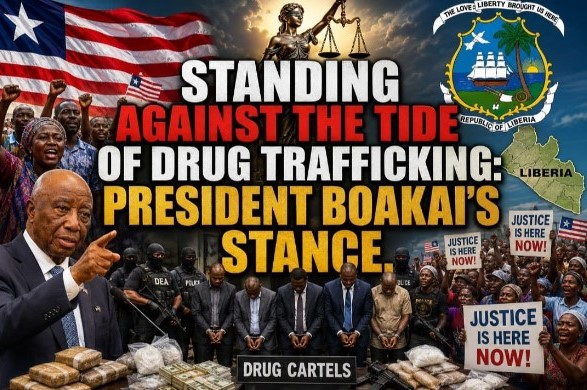
President Joseph Boakai and global leaders: Treat drug trafficking as an existential threat and an attack on national security. Standing against this tide requires relentless, non-selective enforcement, public health interventions, and the dismantling of transnational criminal syndicates.
President Joseph Nyuma Boakai: Liberia will not lose another generation to drugs — not on my watch.”
President Joseph Nyuma Boakai: The fight against drugs will be non-selective and relentless… no status, no title, no uniform, and no connection will protect anyone involved in drugs.”
Presidents around the world similarly frame illicit drug cartels as corrosive forces destroying the institutional and moral fabric of societies.
Global Security Threat: World leaders consistently note that cartels subvert local governance through corruption and financial crimes, turning transit nations into fractured states.
Public Health and Human Capital: International consensus categorizes mass addiction not merely as a criminal justice issue, but as a systematic destruction of a nation’s youth and economic potential.
Collective Defense: Similar to President Boakai’s appeals for community vigilance as the first line of defense, international frameworks stress that security forces alone can not defeat cartels without cutting off financial assets and enforcing aggressive border surveillance.
In a world rife with challenges, few issues carry the weight of societal destruction like the trafficking of dangerous and illicit drugs.
On July 30, 2026, an Executive Mansion press release under the signature of the Presidential Press Secretary, Atty. Kula Fofana, for immediate release, read: (Paraphrased)As we observe President Joseph Nyuma Boakai wielding his metaphorical cutlass-axe, a symbol of his unwavering resolve against those who believe they can engage in such practices without consequence, we must recognize the importance of this movement.
His decisive actions to not only dismiss government officials and employees involved in drug trafficking but also to seek their prosecution mark an unprecedented moment in Liberia’s governance.
This approach is not only commendable but is also indicative of a profound sense of leadership and nationalism that must resonate throughout the nation.
In a country still grappling with the remnants of civil imbroglio-strife and an arduous path towards recovery, the need to eliminate drug trafficking is not just a political stance; it is a societal imperative.
Drug trafficking holds the power to devastate families, undermine social structures, and erode the very fabric of a nation.
Liberia, like many other nations grappling with the scourge of the illegal drug trade, finds itself at a crossroads.
The mere presence of drug traffickers within its borders threatens to dismantle the potential of its future leaders, its youth.
Liberians must remember that the children and young adults of today are the leaders of tomorrow.
Their futures should not be compromised by the parasitic nature of drug trafficking, which seeks to exploit their vulnerabilities and entrap them in cycles of addiction and crime.
President Boakai’s firm stance, supported by a call to action for all Liberians to join forces against traffickers, sends a strong message: that the nation will take no more.
His initiative calls not just for state-level action but also for communal unity.
It encourages citizens from every walk of life to advocate for a drug-free Liberia.
Such communal efforts lead to a robust, united front against the negative influences of drugs.
The sentiment reflects a radical shift towards taking ownership of the nation’s direction, promoting civic engagement and national pride that can eradicate the stigma that has plagued Liberia for far too long.
When Liberians examine the motivations behind drug trafficking, they notice a historical connection to societal instability.
Regions afflicted by war, poverty, and lack of opportunity are often the playgrounds for such illicit activities.
Liberia has endured its share of turmoil, and the subsequent ramifications are visible in the context of drug trafficking.
Young people, lured by the promise of quick money, often fall prey to drug peddlers, who operate under the cloak of darkness, exploiting desperation.
The involvement of these traffickers, who can be viewed as nothing but cowards, detracts from the aspirations of an entire nation and tarnishes Liberia’s international standing.
There’s a need to foster an environment where potential is seen, nurtured, and valued, rather than squandered on illicit gains.
Additionally, the actions taken by President Boakai have ramifications that extend beyond the borders of Liberia.
The involvement of the U.S. government and security sector in the fight against drug trafficking not only strengthens Liberia’s defenses but also reinforces diplomatic ties between the two nations.
This cooperation is vital; international assistance can create a comprehensive approach to tackling drug trafficking, establishing systems for monitoring, prevention, and enforcement.
It is also a step toward restoring trust in Liberia’s leadership both at home and abroad.
By aligning more closely with global efforts against drugs, Liberia signals its commitment to upholding international norms and standards, which is essential for foreign investment and diplomatic relations.
However, the road ahead is not without obstacles.
There remain entrenched interests within Liberia that may oppose President Boakai’s actions; it is no secret that the drug trade can be lucrative.
Those benefiting from it often wield significant power and influence.
Combating such entrenched structures takes more than just political will; it requires transforming mindsets and emphasizing the benefits of societal health and economic stability over quick monetary gain.
An effective strategy must involve collaboration between the government, non-governmental organizations, and community leaders, ensuring that anti-drug messaging permeates through educational systems, public health campaigns, and grassroots initiatives.
It is also crucial to remember that stigma surrounding drug users and traffickers must be approached with empathy rather than disdain.
Those involved in drug-related crimes are often products of their environments, victims of systemic issues that allowed such conditions to flourish.
While rejection should be directed at the act of trafficking itself, the conversation must evolve to include rehabilitation and reintegration for individuals caught in the web of drug-related crime.
Elements of restorative justice offer a strong foundation for addressing the complexities of drug abuse and trafficking while promoting healing within communities.
To truly eradicate drug trafficking from Liberia, there must be a comprehensive framework, a melding of law enforcement, education, and prevention programs, alongside rehabilitation initiatives that cultivate understanding and acceptance.
As President Boakai leads the charge, his administration would greatly benefit from engaging with academic institutions and public health experts to craft policies that address root causes and offer tangible solutions.
This multifaceted approach serves not only to tackle illicit activities but also to reshape the societal narrative surrounding drug use, paving the way for healthier, more informed communities.
President Joseph Nyuma Boakai’s resolute actions against drug trafficking signal a critical juncture for Liberia.
At this moment, the nation can reclaim its identity and assert its sovereignty against destructive forces.
It is a call for unity among all Liberians: a plea to march towards a collective goal of a drug-free nation, free from the chains of addiction that threaten to ensnare the youth.
The protection of future generations is a responsibility that lies with each citizen.
By fostering dialogue, reinforcing strong alliances with international partners, and promoting community-based solutions, Liberia can emerge from the shadows of its past.
In this fight, let us hope that those with courage and foresight will triumph over cowardice, ensuring that Liberia becomes a beacon of hope for other nations wrestling with their struggles against drug trafficking.
With shared determination and collective action, Liberia can, and must, build a brighter future free from drugs and despair.