
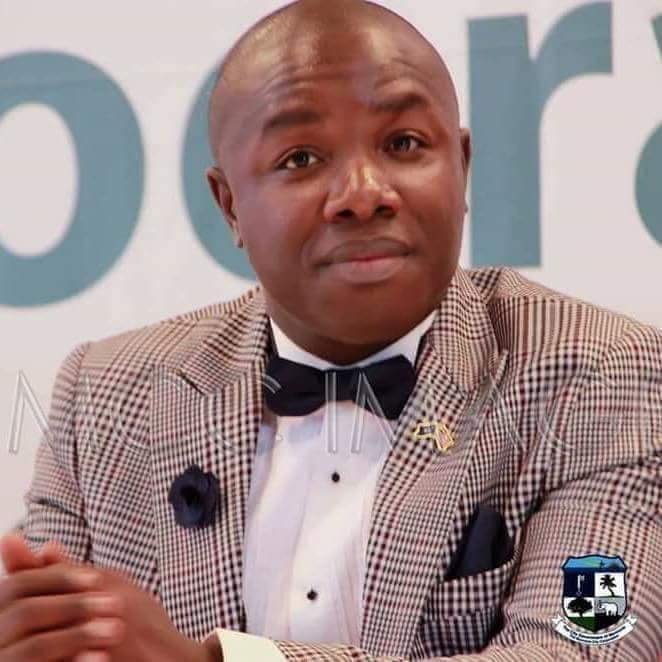
PHOTO: Former Monrovia City Mayor Jefferson Koijee
By A Contributing Writer
Monrovia, Liberia – A recent social media post by a staunch supporter of the ruling Unity Party, Amara Konneh, Jr., has ignited fresh public conversation around the reputation of former Monrovia City Mayor and Congress for Democratic Change (CDC) secretary general, Jefferson Tamba Koijee, highlighting what some observers describe as a shifting narrative shaped by reflection and hindsight. https://www.facebook.com/share/p/1B2FT52ayP/?mibextid=wwXIfr
In a widely circulated Facebook post, Amara Konneh openly acknowledges that he had never supported Mayor Jefferson T. Koijee in the past, but expresses a degree of reconsideration after encountering a recent image of him abroad. The post reflects on years of intense public criticism directed at Koijee, during which he was frequently portrayed as violent, uneducated, and unfit for national leadership.
Coming from Amara Konneh, who has often been criticized for sharing unverified information and engaging in politically charged narratives, including positions that contributed to the sanctioning of Koijee, the statement is framed as a moment of reflection. It situates itself within what he presents as an atmosphere of truth-telling, raising questions about the credibility of past claims and the motivations behind them.
According to Konneh, the repeated portrayals of Koijee across political discourse and public commentary may have contributed to a broader climate of hostility and suspicion. His post invites a deeper examination of whether these narratives were grounded in verified facts or whether they were amplified as part of political contestation, particularly during the tenure of the Coalition for Democratic Change (CDC) government.
Over the years, Mayor Jefferson T. Koijee has been the subject of numerous and state-sponsored propagandas raised by political actors, activists, media figures, and even international stakeholders.
These propaganda and accusations, spanning from 2018 through 2023, have touched on issues of violence, human rights abuses, corruption, and misconduct. However, a recurring feature across many of these claims is that they have either been publicly disputed, lacked substantiating evidence, or were directly refuted by individuals connected to the incidents.
The earliest wave of allegations dates back to 2018 during the District #13 by-election, when Henry Costa accused Koijee of involvement in the fatal shooting of three individuals amid clashes between supporters of the Coalition for Democratic Change (CDC) and the Unity Party.
This claim was amplified by the circulation of an image allegedly showing Koijee holding a weapon, which was later determined to be manipulated. Around the same period, Costa also alleged that Koijee had purchased a US$250,000 property in Sinkor. This claim was challenged by Koijee’s asset declaration and further refuted by Jeremiah Koung, who clarified issues surrounding the property’s ownership.
In a separate allegation in 2018, Costa accused Koijee of killing a man in Caldwell over a land dispute, but no evidence was produced to substantiate the claim.
In 2019, Jerome Verdier, former chairman of the Truth and Reconciliation Commission, accused Koijee of having been a child soldier during Liberia’s civil war and further alleged that he maintained associations with Charles McArthur Emmanuel, the son of former President Charles Taylor. That same year, Stanton Witherspoon, CEO of Spoon Corporation, accused Koijee of transporting weapons into Liberia, an allegation that was later dismissed due to lack of evidence.
Also in 2019, Costa alleged that Koijee orchestrated the kidnapping, rape, and drugging of Jestina Taylor; however, in 2020, Taylor publicly denied the claim and stated that she had been used by political actors to defame the mayor.
The pattern of accusations continued into late 2019 and 2020. On December 23, 2019, Chris Smith, a senior member of the U.S. House of Representatives, accused Koijee of serious human and civil rights violations, including attempted murder, rape, unlawful arrest, detention, and torture. Shortly after, on January 13, 2020, the International Justice Group led by Verdier formally referred Koijee to the International Criminal Court in The Hague for alleged crimes against humanity, but the case was ultimately dismissed for lack of merit. In August 2020, Costa again accused Koijee of orchestrating a kidnapping attempt involving a child through an individual named Bartica Williams.
This allegation was publicly refuted by the child’s mother, Musu Allison, who clarified on radio that no kidnapping had occurred.
More recent allegations emerged between 2022 and 2023, reflecting continued political tensions. In July 2022, Koijee was accused of masterminding violence against university students protesting near the U.S. Embassy in Monrovia. That same year, Verdier further alleged Koijee’s involvement in the killing of the daughter of Gloria Musu Scott, a claim that remains highly contested and unproven.
In April 2023, Koijee was again accused of orchestrating violence during the funeral of former interim president Amos Sawyer at the University of Liberia. Later, on September 25, 2023, he faced allegations of facilitating the release of Kesselle Mulbah from prison, although details surrounding this claim remain unclear. On November 20, 2023, Spoon Network accused Koijee of masterminding an incident at the Unity Party headquarters that resulted in three deaths and multiple injuries, but no conclusive evidence has been publicly presented.
Taken together, these allegations illustrate a sustained pattern of controversy surrounding Mayor Koijee, largely driven by political opponents, activists, and segments of the media. At the same time, the repeated absence of verified evidence, alongside multiple public refutations and institutional dismissals such as that of the ICC, underscores the complexity of separating substantiated claims from politically motivated accusations within Liberia’s highly polarized political environment.
Koijee, who served as a prominent public official and a youth leader under former President George Weah, was often a polarizing figure in Liberia’s political landscape.
His rise within youth and student activism brought both deep admiration and criticism, with detractors accusing him of wielding influence in ways that fueled instability, while supporters viewed him as a mobilizer of young people in national politics.
The recent reflection challenges some of those long-standing accusations, raising questions about the absence of formal charges despite years of serious public claims. It also points to Koijee’s ability to travel and reportedly pursue opportunities abroad as grounds for reconsidering earlier perceptions.
Notably, the post references past allegations linking Koijee to high-profile incidents, including the tragic case of Musu Scott, while questioning why no legal proceedings have materialized if such claims were substantiated.
Political analysts say such public reconsiderations are not uncommon in post-election environments, where narratives shaped during intense political competition are later revisited. “What we are seeing is part of a broader reflection on how political messaging can influence public perception,” Raymond Killie, a political analyst.
“It raises important questions about accountability, but also about fairness.”
The post stops short of fully endorsing Koijee but underscores a growing sentiment among some Liberians who are reassessing past beliefs and asking whether political rivalries may have fueled exaggerated or misleading portrayals.
As Liberia continues to navigate its evolving political landscape, the conversation sparked by this reflection highlights a deeper issue: the power of narrative in shaping reputations, and the challenge of separating fact from political messaging in a highly polarized environment.