
FeatureLiberia Society

POET’S PAGE: The Colony In The Mind

(Last Updated On: )

By Dr. J. Kerkula Foeday

My Weekly Poetic Reflection, Issue 14, Friday, July 10, 2026


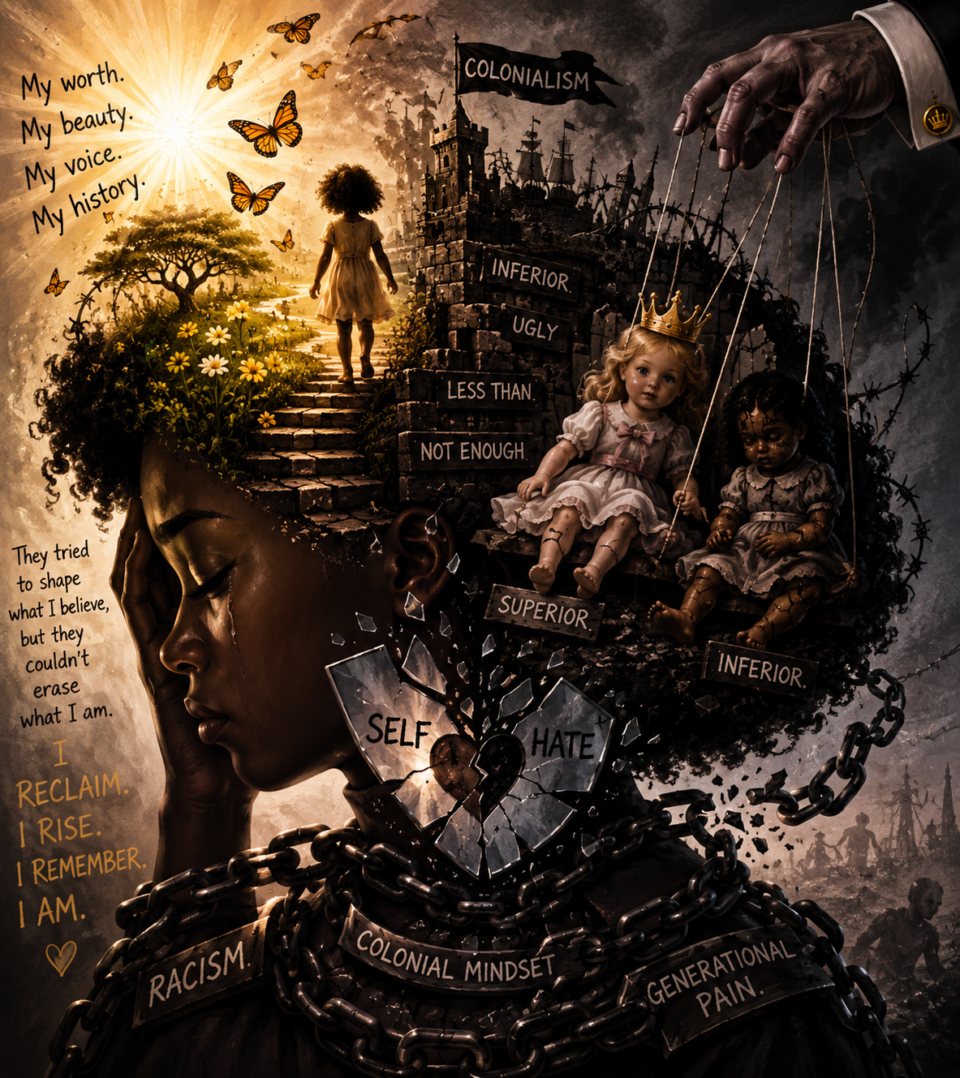
The most enduring colony is not the one imposed upon the land, but the one established within the mind


The colonizer has gone.
The flags have changed.
The impostors have departed.
The chains have fallen.

Yet, something remains.
A colony survives,
Not upon the land,
But within the mind.
Invisible.
Persistent.
Dangerous.

A colony where the conquered
Still doubt themselves.
A colony where black children
Learn to admire distant faces
Before learning to admire their own.
A colony where foreign
Is mistaken for superior,
And African for inferior.
A colony where a people
Slowly become strangers
to themselves.

And so I ask:
Why do you despise your own?
Why do you praise the stranger
While mocking your brother?
Why do you celebrate distant greatness
Yet overlook the genius that lives among you?
Why do you carry your heritage
Like a burden instead of a crown?
Why do you speak your mother’s tongue with embarrassment
Yet wear a foreign accent as a badge of honor?
Why do you run from your roots as though they are chains,
When they are the very source
of your strength?

In Liberia,
I have seen it.
Men and women
Who can recite the histories of Europe,
Yet know little of the stories
of their own people.
Children who know foreign songs
But cannot sing the songs of their ancestors.
Citizens who hide their tribal origins
As though identity were a crime.
Educated minds unable to speak the language of their grandparents.
People ashamed of the very soil that gave them life.

Tell me,
How can a tree despise its roots and still expect to stand?
How can a river reject its source and continue to flow?
How can a people reject themselves and still remain whole?

This sickness did not begin with us.
It was planted.
Watered.
Cultivated.

For colonialism sought
Not merely to occupy territories.
It sought to occupy consciousness.
It taught the conquered
To distrust themselves.
To question their worth.
To admire others excessively,
While diminishing their own reflection.

Frantz Fanon saw these wounds.
He understood that conquest does not end when soldiers depart.

Sometimes, it survives
In the imagination of the conquered.
Sometimes, the final battlefield
is the human mind.

Africa has never lacked greatness.
Never.
The lie is never that Africa l acks genius.
The lie is that Africa lacks value.

The world often speaks of Africa’s gold.
Its diamonds.
Its oil.
Its iron ore.
Its forests.
Its fertile lands.

But Africa’s greatest wealth
has never been buried beneath the ground.
It has always walked🚶‍♂️upon it.

Africa is not only rich in resources.
Africa is rich in minds.
Rich in ideas.
Rich in imagination.
Rich in courage.
Rich in scholars,
Scientists,
Writers,
Artists,
Inventors,
Visionaries,
And transformative leaders.

Consider Philip Chukwurah Emeagwali,
Whose innovations in supercomputing
Helped expand the boundaries
of computational science,
Proving that African intellect
Belongs among the architects of the modern technological age.

Consider Cheikh Anta Diop,
Who challenged distorted histories
And restored Africa to its rightful place
In the story of civilization.

Consider Ibn Khaldun,
Whose study of society, culture,
and political power
Preceded and shaped ideas
That would later become sociology itself.

Consider Frantz Fanon,
Who exposed the psychology of oppression
And called upon the colonized
to reclaim their humanity.

Consider Kwame Nkrumah,
Whose vision stretched beyond borders,
Calling for African unity,
African dignity,
And African self-determination.

Who seized the pen
And told African stories
With such power and authenticity
That the world could no longer pretend not to hear.

Consider Edward Wilmot Blyden,
One of Liberia’s greatest sons,
Who declared long ago that African identity
Was not a weakness to be hidden,
But a strength to be celebrated.

Consider Robtel Neajai Pailey,
Whose scholarship and advocacy continue
The struggle for African voices,
African agency, and African-centered knowledge.

These names are not exceptions.
They are evidence.
Evidence that Africa has contributed
To the physical sciences.
To the natural sciences.
To the social sciences.
To philosophy.
To literature.
To politics.
To culture.
To the advancement of human civilization itself.

And yet,
Too often,
We wait for foreign applause
Before celebrating our own.
Too often,
We require validation from elsewhere
Before recognizing excellence at home.
Too often,
We become experts at importing admiration
While exporting self-respect.

No.
Enough.

The next Philip Emeagwali
May be sitting today
In a crowded classroom in Gbarma.

The next Chinua Achebe
May be scribbling stories
Beneath a kerosene lamp in Fassama.

The next Cheikh Anta Diop
May be questioning
Accepted truths
in a village school.

The next Frantz Fanon
May be searching
for answers
To society’s deepest wounds.

The next Kwame Nkrumah
May be dreaming of a better Africa
Somewhere in a village in Liberia.

The next transformative leader
May be among us right now,
Waiting only for a people
Who believe in themselves.

Therefore,
Cherish your own.
Cherish your language.
Cherish your culture.
Cherish your name.
Cherish your tribe.
Cherish your history.
Cherish your people.
Cherish your continent.

For no people rise
By despising themselves.
No nation becomes great
Through self-contempt.
No civilization flourishes
While being ashamed of its own reflection.

Stand tall.
Stand rooted.
Stand unapologetically African.

Let no one convince you
That your heritage is a handicap.
Let no one persuade you
That your identity is an obstacle.
Let no one teach your children
To doubt the brilliance
that already lives within them.

And when history asks:
What became of a people
once taught to underestimate themselves,
Let the answer be:
They awakened.
They remembered.
They reclaimed their dignity.
They dismantled the colony in the mind.

And at last,
They learned to cherish,
Rather than despise their own.


This poem is in honor of Philip Chukwurah Emeagwali, Chinua Achebe, Bai T. Moore, Edward Wilmot Blyden, and all African geniuses, scholars, and transformative leaders who have proven to the world that black heritage is not a handicap to be ashamed of.

You Might Be Interested In

Weah Calls For Peace Among Divided Marketers, As He Dedicates Huge Modern Market

News Public Trust

George Weah Must Gather From Donald Trump 2nd Term Presidential Fall

News Public Trust

PYJ’s Demise Shortens The List Of Liberia’s Former Warlords To Be Prosecuted For War Crimes

News Public Trust