
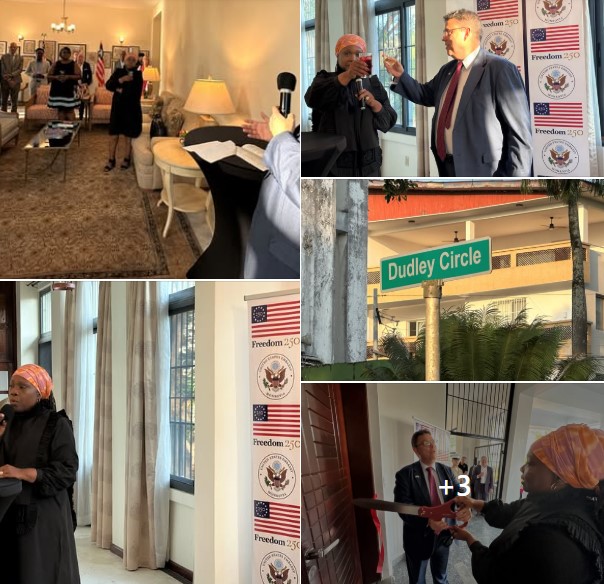
Photo credit: US Embassy, Monrovia
The Chargé d’Affaires at the United States Embassy in Monrovia, Joe Zadrozny yesterday, March 31, 2026 provided a deep historical insight on the development of diplomatic relations between his country and Liberia, Africa’s first black republic dating back to nearly a century.
He specifically highlighted the historical construction of the first building used to house the US diplomatic mission in Liberia exactly 85 years ago, which was later upgraded to an embassy.
In a statement during the “grand reopening of the Deputy Chief of Mission residence” in the diplomatic enclave of Mamba Poont Mr. Zadrozny said:
“The I chose this date, March 31st as a special occasion for celebration because 85 years ago on March 31, 1941, the U.S. Minister to Liberia Lester A. Walton formally opened the building in which we are now standing as the new American legation in Monrovia.”
He explained that Legation is a historic diplomatic term no longer used but was diplomatic representation one step below embassy.
BEKIW US FULL TEXT OF THE US EMBASSY’S Chargé d’Affaires:
Remarks by Chargé d’Affaires Joe Zadrozny
at the Re-opening of the United States Legation House (1941)
(as written)
March 31, 2026
Good evening and thank you all for coming this evening.
I invited you here today as part of our year-long celebration of America’s 250th birthday– our semiquincentennial. Two hundred fifty years ago, in the summer of 1776, 56 of America’s Founding Fathers gathered in the fledgling nation’s then capital city Philadelphia to sign a Declaration of Independence, which launched history’s boldest experiment in self-governance, the United States of America.
And so, for this entire year, we are celebrating Freedom 250 with a variety of activities that share America’s history, values, and ideals. Our public affairs section has hosted presentations with students on influential Americans in business, political and civil rights, as well as about American monuments and even original American sports like basketball.
Earlier this month, our interagency health team, working with the Ministry of Health and NPHIL, reviewed our shared progress in global health security. Together, we strengthened JFK Hospital—expanding imaging, improving the microbiology lab, and providing sustained technical support. We backed pandemic and emergency responses, expanded diagnostic capacity at the national reference lab, and advanced clinical and vaccine research that helped license critical vaccines and treatments.
Looking ahead, our Global Health Security Strategy will build on this foundation. We will prioritize early detection and rapid response, reinforce resilient health systems, and deepen scientific and regulatory collaboration so Liberia can independently and sustainably prevent, detect, and respond to health threats—such as HIV and malaria—protecting communities here and around the world.
Last month Peace Corps celebrated its 65th anniversary since its founding by President Kennedy in 1961…with the first Peace Corps volunteers arriving in Liberia the very next year in 1962. And over the last 60 plus years, over 4000 Americans have served as Peace Corps volunteers across all 15 counties of Liberia—including Mark Toner our last Ambassador.
Also last month, we had a visiting delegation from the Michigan National Guard, including Adjutant General of the Michigan National Guard, General Rogers. The Michigan National Guard and AFL have been working closely over the past 15 plus years.
I chose this date, March 31st as a special occasion for celebration because 85 years ago on March 31, 1941, the U.S. Minister to Liberia Lester A. Walton formally opened the building in which we are now standing as the new American legation in Monrovia. (Note: Legation is a historic diplomatic term no longer used but was diplomatic representation one step below embassy.)
I want to share a brief quote from a newspaper article printed when the building of the new legation building was announced: “It’s being built on the summit of a cape ending in the Atlantic and will face the ocean. Weeks of dynamiting were necessary to level huge boulders on the rocky site Soil was then spread so that trees and flower may grow”. “The Cape is the coolest part of Monrovia but had never before been used for dwellings because of its rugged state”. If you look in the front room of the house at some of the old photos, you will see that at that time there were no trees here and so there were no bats…if you didn’t notice, we have a colony of an estimated quarter of a million brown bats at roost here on our compound during the dry season. They are entertaining but can be loud and messy.
When it first opened, this building housed the legation offices and the Minister’s residence. During the opening, Minister Walton hosted a group of distinguished guests, including members of the diplomatic corps –the UK, Germany, the Papal Nuccio, and officials from the government of Liberia, including the President and Secretary of State, and American citizens and company employees of Firestone…which means many of you are standing in the same spot your predecessor’s may have stood when the house was opened 85 years ago.
In his toast, Minister Walton noted that the United States had had representation in Liberia since 1866, but until then, the American Legation had been housed in a series of rented houses. He also noted with a degree of national pride that “this building is the most modernly constructed on the West Africa coast and is an attestation to the U.S. government’s faith in Liberia and a forthright expression of optimism in Liberia’s strength and will to prevail as a separate, independent state in the community of nations.”
In his responding toast, President Edwin Barclay offered his congratulations upon completion of the building that he said, “symbolizes the permanence of those close political and spiritual relations, which unite our two governments and peoples.”
The Embassy outgrew this building by the early 1950s and in 1956, when a new embassy was built next door, this entire building became the Ambassador’s residence. Then in 1992, the Ambassador moved into the former UK embassy at the other end of the compound, and this building became the Marine House that housed our security detachment. And then when the Embassy moved into our new embassy compound in 2013, the Marines moved as well to that compound and this building became the Deputy Chief of Mission’s residence.
And so, in addition to celebrating the significance of this building, it is also worth recognizing two people who played pivotal roles in the U.S.-Liberian relationship: Lester A. Walton and Edward R. Dudley.
Minister Walton was a visionary leader, who served here in Liberia for more than ten years. It was his idea to build a permanent building, and he pressed to have the status of the legation raised to that of an embassy.
It was one of his successors, Edward R. Dudley, who became the first American Ambassador to Liberia and the first African-American United States Ambassador period. Ambassador Dudley was a lawyer, judge, and civil rights activist, and he served as Governor of the U.S. Virgin Islands. It was Dudley, who pressed the State Department to expand opportunities for African American diplomats beyond a limited number of postings in Africa. And so today we recognize his activism for change in the system. And in a few minutes, if you indulge me, we will go outside to unveil a new sign renaming the street in front of the residence as Dudley Circle.
Ladies and Gentlemen, on this auspicious occasion, I would like to offer a toast to 250 years of American independence and to the next 85 years of U.S.- Liberian relations. Perhaps one day in the distant future, some of our successors will again gather in this historic house to celebrate the longevity of American democracy and to renew the bonds of American-Liberian friendship.