
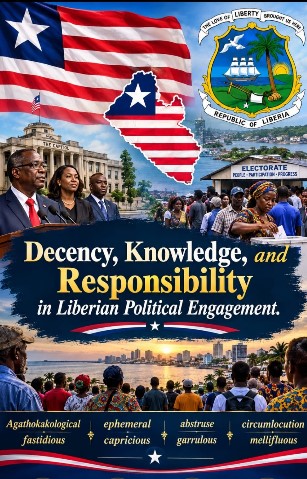
By Austin S. Fallah – A True Son of the Planet Earth Soil: fallahas@yahoo.com
A person is judged not by the mistakes they make but by who they become after recognizing those mistakes and the changes they make.
https://www.facebook.com/share/v/18Qqx4YrQu/
https://www.facebook.com/share/v/1DriGKb2LD/
https://www.facebook.com/share/v/17diYVfcqV/
President of Liberia Joseph Nyuma Boakai : “Election is not an event. It is a process which must not be merely observed but monitored over a period of time.” He connected political participation with advancing peace, democratic entitlements, and good governance.
President Joseph Nyuma Boakai: In September 2026, Boakai emphasized the importance of a “free, responsible, professional, and vibrant media.” In Liberia’s democratic development, while encouraging journalists to tell Liberia’s story with “truth, balance, dignity, and confidence.”
Liberian political parties — Farmington River Declaration
Liberia’s political parties pledged to a: “NON-VIOLENT, FREE, FAIR, and TRANSPARENT”
electoral process in the 2023 Farmington River Declaration. The declaration involved political parties, Liberia’s National Elections Commission, ECOWAS, and the United Nations.
The UN’s Deputy Secretary-General emphasized:
“The responsibility for a successful and credible election lies not only with the electoral management body but also with the entire range of political parties, civil society – and, of course, voters.”
Inter-Parliamentary Union
The IPU’s Universal Declaration on Democracy states that democracy should be exercised under conditions of:“freedom, equality, transparency and responsibility”
George Manneh Weah — Former President of Liberia: On responsible political participation: “It requires the fully committed participation of all citizens and the support of Liberia’s friendly partners.” Former President Weah made this statement in August 2023 while discussing the responsibility of citizens and stakeholders for peaceful and credible elections.
“Patriotism does not mean blindly, unquestioningly to power.” — Former President Ellen Johnson Sirleaf.
António Guterres — UN Secretary-General: In his 2026 International Day of Democracy message, Guterres stated: “Democracy is more than elections.”
Former South African President Nelson Mandela:
“A real leader uses every issue, no matter how serious and sensitive, to ensure that at the end, the nation should emerge stronger and more united than ever before.”
“Stand up in yours, for Commission’s procedures’s procedures’s procedures’s procedures’s procedures’s proceduresy be human together.”- Desmond Tutu
“Intelligence plus character—that’s the hallmark of true education.” — Martin Luther King Jr.
Liberian politics will not move forward merely because elections are held, political parties are registered, or citizens have access to Facebook, WhatsApp, TikTok, radio talk shows, and other forms of public communication.
Democracy is not only the right to speak; it is also the responsibility to speak with care, knowledge, and respect for the consequences of one’s words.
Liberia’s political future depends on whether its citizens, leaders, journalists, constructive activists, and diaspora communities can replace reckless political performance with serious democratic engagement.
Too often, the national conversation is dominated by half-hazard commentary from ill-informed individuals who treat social media as a battlefield rather than a civic space.
The concern is not that ordinary people participate in politics.
On the contrary, broad participation is necessary in any functioning democracy.
The danger arises when people with limited knowledge of history, policy, law, economics, and public administration present rumors as fact, insults as arguments, and personal loyalty as patriotism.
When political discourse becomes controlled by political nobodies seeking attention rather than solutions, the entire country pays a price.
Education is not limited to formal degrees.
A person may not have attended college and still possess wisdom, humility, integrity, and a deep understanding of community needs.
Likewise, a person with many academic credentials may still be dishonest, arrogant, or detached from ordinary citizens.
However, political engagement requires a willingness to learn.
It requires citizens to investigate claims, understand institutions, distinguish fact from fiction, expose corrupt individuals who refuse to punish wrongdoing, and contribute meaningfully to national development, no matter how loud that person may be online.
Liberia has endured civil conflict, institutional weakness, economic hardship, corruption, distrust, and social division.
These are not minor matters to be explained away with slogans or partisan insults.
The consequences of political recklessness are profound.
Words can influence voter behavior, damage reputations, deepen ethnic tension, discourage investment, and even create conditions for violence.
A false accusation posted casually on social media can spread through communities with astonishing speed.
By the time the truth appears, the damage may already be done.
For this reason, Liberians must take seriously the social, political, and economic r
Political criticism is essential, but criticism should not become demonization.
There is a major difference between questioning a government’s budget priorities and calling every official a criminal without evidence.
There is a difference between opposing a president and wishing for national failure simply to embarrass that president.
There is also a difference between demanding accountability and attempting to demon-cratize (self-created word) every person who holds a different political view.
When political opponents are treated as enemies of the nation, democratic competition becomes destructive rather than productive.
The word “demon-cratized(self-created word) captures a troubling tendency in contemporary politics: the effort to turn democratic debate into a contest of moral destruction.
Important issues such as education, health care, youth unemployment, infrastructure, national security, land rights, corruption, and constitutional reform are too vast to be demon-cratized (self-created word).
They can not be resolved by portraying one group as entirely good and another as entirely evil.
Every administration will make mistakes.
Every political party will contain both sincere public servants and self-interested actors.
The duty of citizens is not to unquestioningly defend or automatically condemn.
Their duty is to examine facts, ask difficult questions, and demand better policies.
Unfortunately, some political discussants appear intellectually illiterate in the sense that they lack the discipline of serious analysis.
They may discuss national debt without understanding public finance, speak about the Constitution without reading it, or make claims about elections without knowing the National Elections Commission’s procedures.
They may improvise arguments from fragments of hearsay, screenshots, anonymous recordings, or statements taken out of context.
Such conduct creates confusion rather than enlightenment.
It transforms civic discussion into a competition over who can make the most shocking accusation.
This problem is especially severe on social media because the platforms reward speed, outrage, and emotional reaction.
A careful explanation of a government policy may receive little attention, while an insulting video or inflammatory post may attract copious comments and shares.
Some individuals have learned that anger brings visibility.
They therefore manufacture controversy, use condescending language toward those who disagree, and present themselves as the only honest voices in the country.
Yet volume is not wisdom. A person who insults everyone else is not necessarily courageous; that person may simply lack the capacity to persuade through evidence.
Liberia needs a political culture that values substance over spectacle.
Citizens should ask practical questions: What is the proposed policy?
How will it be funded?
Who will benefit?
What are the risks?
What does the law permit?
What evidence supports the claim?
These questions may sound ordinary, but they are the foundation of responsible citizenship.
They force political actors to move beyond slogans and explain their plans.
They also prevent the public from becoming complacent.
A complacent population allows leaders to operate without scrutiny, while an angry but uninformed population can be manipulated by anyone skilled at emotional propaganda.
At the same time, citizens must resist the temptation to assume that every political disagreement is part of a clandestine conspiracy.
Governments sometimes make poor decisions because of incompetence, limited resources, conflicting priorities, or weak planning, not necessarily because every official is secretly plotting against the country.
Corruption: Expose corruption; provide evidence; and punish wrongdoing through lawful institutions.
However, an atmosphere in which every event is treated as proof of a hidden conspiracy weakens public trust and distracts from real accountability.
When allegations are based only on conjecture, the public becomes unable to distinguish genuine scandal from political fiction.
Responsible engagement also requires leaders to behave differently.
It would be unfair to blame only ordinary social-media users for Liberia’s political problems.
Senior politicians often model the same destructive behavior they later condemn.
They attack opponents personally, use divisive language, make unrealistic promises, and exploit citizens’ frustrations during campaigns.
Some leaders encourage supporters to defend them with implacable loyalty, as if allegiance to a politician were more important than allegiance to the Republic of Liberia.
This is dangerous. No president, senator, representative, party chairperson, or constructive activist should be above criticism.
The nation is greater than any individual politician’s career.
Political leaders should understand that their words carry implicit authority.
When a respected public figure makes an unverified accusation, supporters may act on it.
When a leader ridicules an ethnic group, a region, or a political opponent, that message can spread far beyond the original audience.
Leaders must therefore communicate with discipline.
They should correct misinformation from their own supporters, discourage threats and harassment, and make it clear that political competition must remain peaceful.
A democracy cannot survive if politicians gain power by encouraging citizens to hate one another.
The media also has a central role. Journalism and journalist should not become public relations agents for political parties, nor should they become entertainers who turn every public issue into a shouting match.
Investigative journalism is necessary, especially in a country where public resources must be closely monitored.
But journalism must be grounded in verification, fairness, and context.
Publishing unconfirmed allegations may bring temporary attention, but it can destroy credibility and harm innocent people.
The media should educate citizens about governance, explain legislative decisions, analyze budgets, and provide space for competing ideas without making the public to reduce every disagreement to insult.
Civic education must also be strengthened.
Many Liberians have opinions about politics, but opinions alone do not create informed citizenship.
High schools, universities, churches, mosques, community organizations, radio stations,talk shows, and positive civil society groups should teach citizens how government works.
People should understand the responsibilities of the executive, legislature, and judiciary.
They should understand their voting rights, the importance of peaceful transitions of power, and the legal consequences of defamation, threats, and incitement.
Civic education should not be treated as optional. It is as important to democracy as roads are to commerce.
Moreover, Liberia’s young people should be encouraged to participate constructively rather than merely follow political influencers.
Young citizens have energy, creativity, and a strong desire for change.
They can organize community discussions, monitor public projects, promote voter education, and hold leaders accountable through lawful means.
They can use technology to share accurate information rather than false rumors.
They can also reject the false choice between silence and abuse.
One does not have to be silent in order to be respectful, and one does not have to be abusive in order to be bold.
The country must also recognize that political culture is not immutable.
Liberia is not permanently condemned to a politics of insults, rumors, tribal suspicion, and personality worship.
Political habits can change when citizens demand change.
They change when voters refuse to reward candidates who offer only insults and empty good-for-nothing propaganda.
They change when party supporters hold their own leaders accountable.
They change when public officials understand that their performance, not their propaganda, will determine their legitimacy.
Most importantly, they change when citizens reject the idea that cruelty is strength and that decency is weakness.
Decency in political democratic engagement should characterize engagement, not trivialize important issues that are too vast to be reduced to personal attacks.
Decency does not mean avoiding difficult debates. It means debating difficult m
It means challenging a policy without attacking a person’s humanity.
It means recognizing that an opponent today may become a partner in nation-building tomorrow.
Liberia’s challenges require cooperation across party lines, generations, regions, and social classes.
Liberian politics will not move forward if public debate remains dominated by ill-informed rhetoric, careless allegations, and individuals who pursue relevance through outrage.
The nation needs citizens who read, listen, verify, reason, speak and write responsibly.
It needs leaders who welcome accountability rather than demand unquestioning loyalty.
It needs media institutions that value truth over sensationalism and young people w
Liberia can not build a stable democracy through insults, demonization, and endless online conflict.
It can move forward only through knowledge, humility, courage, accountability, and a shared commitment to the common good.