
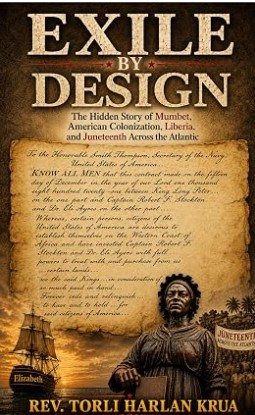
EXILE BY DESIGN: The Hidden Story Of Mumbet, American Colonization, Liberia,And Juneteenth Across The Atlantic
245 Years Hidden Story of Mumbet, American Colonization, Liberia, and Juneteenth Across the AtlanticWhat if one of America’s greatest secrets has been hidden in plain sight for more than two centuries?
In 1776, before there was a federal Constitution, the Declaration of Independence proclaimed that “all men are created equal” and possess the unalienable rights to “Life, Liberty and the pursuit of Happiness.” Yet millions of Black people whose labor and sacrifices helped build America were excluded from that promise because of race.
Four years later, Elizabeth “Mumbet” Freeman, an illiterate, and enslaved Black woman, heard the Massachusetts Constitution declare that “all men are born free and equal.” Refusing to accept the contradiction between slavery and liberty, she went to court. On August 22, 1781, Mumbet and her co-plaintiff, Brom, won their freedom, 30 shillings each in damages, and court costs in the landark lawsuit, Brom & Bett v. Ashley. Their victory, followed by the 1783 Quock Walker decisions, helped abolished slavery in Massachusetts, 82 years before the 13th Amendment effectively ended slavery on December 6, 1865.
But Black freedom provoked a powerful backlash.
Instead of extending Mumbet’s victory, America protected slavery and promoted colonization—the removal of free Black citizens from the United States. The Constitution accommodated slavery through provisions including the Three-Fifths Clause. In 1790, Congress restricted naturalized citizenship to “free white persons.” Ten of America’s first twelve presidents enslaved people.
In 1819, Congress authorized federal funding, presidential action, and the use of the U.S. Navy to return Africans rescued from illegal slave ships to Africa. These actions helped establish the settlement that became Liberia.
Exile by Designinvestigates the roles of the United States government, the U.S. Navy, and the American Colonization Society in Liberia’s creation. It examines congressional funding, contested land ownership, the Society’s disputed legal authority, the raising of the American flag on April 25, 1822, and the restricted political process that produced Liberia’s 1847 declaration of independence-the 25th American in West Africa.
The Colonization Society was led by powerful enslavers whose names remain honored across Liberia: President James Monroe in Monrovia; Justice Bushrod Washington on Bushrod Island; Chief Justice John Marshall in Marshall City and the former Marshall Territory; and Speaker Henry Clay, a longtime Society president.
Yet Liberia’s public landscape gives little recognition to antislavery and anticolonization champions such as William Lloyd Garrison, Frederick Douglass, John Brown, David Walker, and Sojourner Truth.
Nearly two centuries later, Rev. Torli H. Krua’s encounter with a woman and child facing violence after being denied a U.S. visa launched his investigation into America’s hidden relationship with Liberia. His search led to Ziah Village, where Massachusetts Representative Benjamin Swan Sr. invoked Liberia’s 1824 constitutional promise:
“All persons born in Liberia are free and entitled to all the rights and privileges enjoyed by citizens of the United States.”
Today, citizens of dozens of countries may travel to America without visas, but no African country participates in the Visa Waiver Program—not even Liberia.
Provocative, personal, and grounded in historical documents, Exile by Design connects Mumbet’s victory, American colonization, Liberia’s founding, modern immigration inequality, and Representative Swan’s declaration—what Rev. Krua calls “Juneteenth Across the Atlantic.”
Was this enduring contradiction an accident of history—or was it exile by design? Amazon.com: EXILE BY DESIGN: The Hidden Story Of Mumbet, American Colonization, Liberia,And Juneteenth Across The Atlantic eBook : Krua, Rev. Torli Harlan: Kindle Store