
By Austin S Fallah – True Son of the Planet Earth Soil. fallahas@yahoo.com
“National unity does not require uniformity of thought. It does not silence criticism or suppress debate.” — President Joseph Nyuma Boakai, New Year Message on National Unity, January 1, 2026.
“Disagreement must never descend into hostility.” — President Joseph Nyuma Boakai, New Year Message on National Unity, January 1, 2026.
“What unites us is bigger than what divides us.” — President Boakai, Inaugural Address, January 22, 2024. FrontPage Africa Online.
“There is only one Liberia! We share a common Citizenship!” — President Boakai, Inaugural Address, January 22, 2024.
Former President George Manneh Weah — Personal Choice & Democratic Will: “We must let the people decide, and then we must respect their decision. That is indeed the true essence of democracy.”
“Blood should never be the price tag for democracy.” —Former President George Manneh Weah, Inaugural Address, January 22, 2018.
“This government will continue to protect the fundamental rights and freedoms of all Liberians – irrespective of their political affiliation, tribe and religion.”— Former President George Manneh Weah, June 11, 2019.
“This transition was achieved by the free and democratic will of the Liberian people, guaranteed by the rule of law.”— Former President George Manneh Weah, January 22, 2018.
“Democracy is the system of government that surpasses all others; grounded in rule-of-law, respect for individual and human rights, and for institutions, which can arbitrate between competing political interests on behalf of the people.”— Former resident Ellen Johnson Sirleaf, Georgetown University forum, December 6, 2017.
Hon. Alexander B. Cummins: ” We gotta stop this crap mentality where we pull each other down.”
(Spoken in September 2026, urging opposition figures and politicians to focus on constructive ideas instead of tearing one another down.)
Hon. Simeon Freeman: “Each of us on this podium has a big ego, each of us has a big heart, and each of us has a plan to develop Liberia, but everyone can not be president at the same time. So, we are willing to bend our egos, unite our vision, and drive our country forward.”
(Delivered in mid-2026 during a speech on building a consolidated front for national development.)
Hon. Simeon Freeman: ” Musa Bility: Can’t criticize an unborn child. We will work with him in the future.”
Hon. Musa Hassan Bility: “Unite the nation, leaving no tribe behind and prioritizing competence over connections to create one Liberia for all Liberians.”
Hon. Musa Hassan Bility: “Emphasized that political factions should gracefully accept democratic realities instead of resorting to protests or engaging in disruptive activities, calling for a constructive approach to maintaining national stability.”
Hon. Alhaji Kromah:US-based Liberian SQL Subject Matter Expert:“When political leaders hesitate, ordinary Liberians bear the consequences; democratic respect requires that citizens’ choices be heard, honored, and acted upon.”
“There’s nothing more secure than a democratic, accountable, and participatory form of government.” — Wole Soyinka.
Hon. Edward Wesee:”Political freedom is individual; democracy is collective. Personal choice gives democracy its voice, while democratic respect gives that choice its protection.”
Hon. Alexander Torbor Kun:“Political freedom means having the liberty to speak and participate; personal choice means having the right to choose one’s leaders and political convictions; democratic respect means honoring the lawful choices of others, even when we disagree with them.”
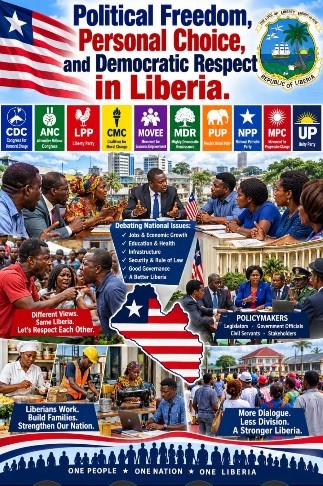
Liberia’s constitutional democracy rests on a simple but powerful principle: citizens are not the property of political parties, political leaders, or political movements.
Every Liberian possesses the freedom to think independently, to associate with others, and to decide which political party, candidate, ideology, or civic cause best represents his or her interests and convictions.
This freedom necessarily includes the right to join a political party, remain in it, disagree with it, disassociate from it, or leave it entirely.
Political affiliation is a personal choice, not a lifetime sentence.
It is a democratic right, not a test of permanent loyalty to any individual or organization.
The Constitution of Liberia recognizes the importance of freedom of association and peaceful political participation.
These protections are essential because democracy cannot function where citizens are forced to support parties against their conscience or are intimidated for changing their minds.
A person may support one political party during one election cycle and another party in the next.
A person may leave a party because of disagreement with its leadership, disappointment with its policies, concerns about corruption, personal values, regional interests, or a sincere belief that another political platform offers a better future for Liberia.
None of these reasons makes that person a traitor. None justifies public humiliation, harassment, or political name calling.
Unfortunately, political discourse in Liberia too often becomes hostile when individuals exercise their constitutional freedom to make independent choices.
Instead of debating policy, leadership, and national development, some political street peddlers resort to insults.
They call people “betrayal,” “ambivalent,” “whiffler,” “truculent,” or other degrading labels intended to shame them for leaving a party, supporting a new candidate, or refusing to follow a political crowd.
Such language does not strengthen democracy. It weakens it.
It replaces reason with resentment, dialogue with hostility, and citizenship with political servitude.
It is important to clarify that freedom of speech is also a constitutional value.
Citizens have the right to express criticism, disagreement, and disappointment.
Political debate is not supposed to be silent or timid.
A democracy requires vigorous discussion.
People should be able to question why a leader changed parties, criticize the timing of a political decision, or challenge the policy positions of a former ally.
However, there is a major difference between criticism and character assassination. There is a difference between asking, “Why did you leave this party?” and declaring, “You are worthless because you left.”
There is a difference between debating a person’s public record and attempting to destroy that person’s dignity.
The constitutional freedom to speak does not create a moral license to insult, intimidate, or manipulate fellow citizens.
Rights come with responsibilities.
A political environment in which people fear being cursed, ridiculed, threatened, or socially isolated for making personal decisions is not fully democratic, even if elections are held regularly.
Democracy is more than voting day.
It is a culture of mutual respect, personal liberty, lawful participation, and peaceful disagreement.
A truly perspicacious political observer understands that party switching, political independence, and changes in allegiance are not always signs of dishonesty.
Sometimes they are signs of growth.
Sometimes they reflect a person’s deeper understanding of national issues.
Sometimes they arise from disappointment with leaders who failed to keep promises.
At other times, they may result from a desire to serve Liberia in a different capacity.
The point is that the citizen, not the political party, owns his or her conscience.
No party should expect blind loyalty from its members.
Loyalty is valuable when it is based on shared principles, trust, accountability, and genuine belief in a common mission.
But loyalty becomes dangerous when it is demanded without question.
When party leaders and supporters insist that members must never leave, never criticize, and never reconsider their political position, they are not promoting democratic loyalty.
They are promoting political captivity. Liberia fought too hard to move away from systems in which a small number of powerful people controlled the choices, voices, and destinies of the majority.
Those who condemn every person who changes political affiliation often act as though politics is a football match in which citizens must defend one team forever, regardless of performance.
But national politics is far more serious than sports rivalry.
Political decisions affect education, health care, roads, jobs, security, justice, agriculture, women’s empowerment, youth development, and the future of the next generation.
If a citizen believes that another party or candidate can better address these issues, that citizen has every right to reconsider his or her political affiliation.
Indeed, a political system that permits individuals to leave parties freely may be healthier than one where members remain only because they fear insults and retaliation.
Parties should ask themselves difficult questions when members depart.
Have they listened to their supporters?
Have they maintained internal democracy?
Have they respected local voices? Have they fulfilled their promises?
Have they treated ordinary members with dignity?
Instead of attacking those who leave, political leaders should reflect on why people no longer feel represented.
The tendency to insult political defectors or independent-minded citizens reveals an unfortunate and benighted understanding of democracy.
It assumes that political leaders deserve unquestioned devotion and that citizens are incapable of making intelligent decisions for themselves.
Such thinking is deeply harmful. It treats adults as though they are political possessions to be controlled rather than citizens with minds, rights, and agency.
A democratic Liberia must reject this mentality.
Equally troubling is the rise of an ochlocratic political culture, where angry crowds, rumor networks, and emotional mob pressure attempt to dictate what individuals may believe or whom they may support.
Ochlocrat, government or public influence driven by unruly crowd passions rather than informed civic judgment, is the enemy of responsible democracy.
When people are pressured to conform because they fear online attacks, community gossip, political harassment, or threats from party loyalists, public life becomes governed by intimidation rather than ideas.
Liberia needs political citizens, not political mobs. Citizens think, question, evaluate, and decide.
Mobs react, insult, and demand blind obedience.
Citizens recognize that another person may make a different political choice without becoming an enemy of the state.
Mobs treat disagreement as betrayal and difference as hostility. Liberia’s future depends on choosing the first path.
The language used by some political actors also reflects a supercilious attitude, a posture of arrogance and self-importance that assumes one group possesses all wisdom while everyone else is foolish, disloyal, or morally inferior.
Whether the word is used in its ordinary rhetorical sense or as a description of inflated political pride, the message is clear: no political camp has a monopoly on patriotism.
A member of one party can love Liberia. A member of another party can also love Liberia.
An independent citizen can love Liberia. A person who leaves a ruling party, opposition party, or coalition can still be committed to peace, development, and national unity.
Patriotism should not be measured by the color of one’s political T-shirt, the slogan one repeats, or the leader one praises.
Patriotism is demonstrated through constructive conduct: obeying the law, respecting others, paying attention to national issues, rejecting violence, promoting peace, serving one’s community, and holding leaders accountable.
It is possible to disagree politically while remaining united in love for Liberia.
The use of insulting labels is especially dangerous because it often encourages a misanthropic view of political opponents.
When citizens begin to see those with different political choices as enemies, fools, traitors, or people unworthy of respect, political disagreement turns into hatred of fellow human beings.
Such hostility can easily grow into violence, exclusion, and social division.
Liberia’s history teaches that political tensions must never be treated lightly.
Words can create wounds, deepen distrust, and prepare the ground for dangerous actions.
For that reason, political leaders, youth groups, media institutions, constructive civil society organizations, religious leaders, and ordinary citizens must promote a new standard of public discourse.
Political leaders should publicly discourage their supporters from insulting former members or attacking people who make different choices.
They should teach supporters that winning an argument requires evidence, not abuse.
Party officials should establish internal grievance procedures so that dissatisfied members can raise concerns without fear.
The media should provide space for substantive debates on policy rather than rewarding the loudest insult or most sensational accusation.
Young people, in particular, have an important role to play.
Liberia’s youth are energetic, creative, and increasingly active in public life.
They should not allow themselves to be used as instruments of political intimidation.
A young person who spends every day insulting others online or in the streets is not defending democracy; that person is damaging the democratic culture that future generations will inherit.
Young Liberians should demand employment opportunities, quality education, accountable leadership, transparent public spending, and peace, not merely slogans and political quarrels.
The phrase that insulting political actors belong in the “dungeons of demon-crisis” or a “demon-cratic(self made word)” world may express understandable frustration with uncivil political behavior.
Yet Liberia must be careful not to answer verbal intolerance with another form of intolerance.
In a democracy, people should not literally be placed in dungeons simply because they speak foolishly, harshly, or offensively.
The proper response to bad speech is better speech, civic education, moral accountability, peaceful correction, and, where conduct crosses legal lines into threats or incitement, lawful due process.
Democratic society must not imitate the oppressive behavior it condemns.
Therefore, the goal should not be to silence political street peddlers, but to expose the weakness of their arguments.
When someone insults another citizen for changing parties, Liberians should ask: What policy issue is being discussed? What evidence supports the accusation? Why is personal abuse replacing reasoned debate?
These questions can help transform the political conversation.
They can reveal that insults are often used when a person has no persuasive argument to offer.
In the final analysis, political freedom means the freedom to choose without coercion.
A Liberian citizen should be able to join a party with confidence, leave a party with dignity, support an independent candidate without fear, and criticize leaders without intimidation.
No one should be condemned for following his or her conscience.
Political parties are important vehicles for democratic participation, but they must never become prisons for the minds of citizens.
Liberia’s democracy will become stronger when political actors understand that people are free agents of their own thoughts and decisions.
They should be free from manipulation, free from condemnation, and free from the poisonous assumption that changing one’s political affiliation is an act of betrayal.
The nation needs principled debate, not personal attacks; informed citizens, not manipulated crowds; and leaders humble enough to accept that no party owns the people.
Respect for political choice is not a weakness. It is the foundation of democratic strength.