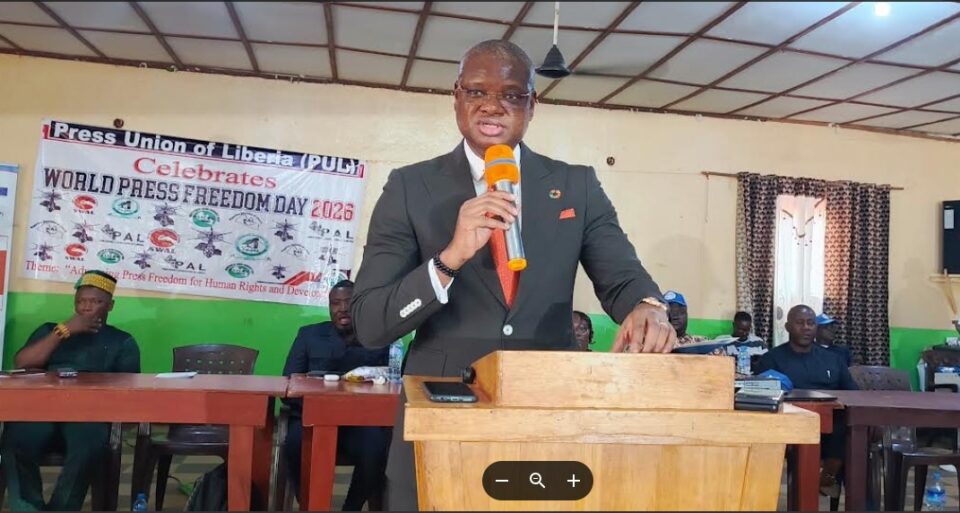
PHOTO: Mr. Aliou Mamadou Dia, UNDP Resident Representative in Liberia addressing World Press Freedom Day program in Kakata, Liberia
Special Remarks by:
Mr. Aliou Mamadou Dia
Resident Representative, United Nations Development Program
World Press Freedom Day
May 4th, 2026
Kakata City, Margibi Country, Liberia
Theme – Shaping a World at Peace: Promoting Press Freedom for Human Rights, Security, and Development
Protocol observed.
- Government representatives,
- Civil society partners,
- Members of the diplomatic corps,
- Distinguished members of the media, who we are celebrating today,
- Ladies and gentlemen,
It is a great honour to join you today as we commemorate World Press Freedom Day, under the global theme “Shaping a World at Peace: Promoting Press Freedom for Human Rights, Security, and Development.”
This theme is particularly timely in the context of today’s global and national realities.
Peace, democracy, and sustainable development all depend on the free flow of information, the courage of journalists, and our collective commitment to defending truth.
Press Freedom is the Backbone of Democracy and Human Rights.
A free, independent, and pluralistic press is the lifeblood of every democratic society. Through the media, citizens are informed, leaders are held accountable, and human rights are protected.
Where the media is free, societies are more transparent, inclusive, and resilient.
Liberia’s media landscape has demonstrated remarkable resilience. Across the country, journalists continue to advance transparency, provide critical oversight, and amplify the voices of communities—often under challenging circumstances.
At the same time, we are fully aware of the growing threats journalists are faced with such as risks to personal safety, financial pressures, online harassment, and the rapid spread of misinformation and disinformation.
Let me be clear, a journalist safety is non‑negotiable. No reporter should ever be intimidated, assaulted, or silenced for doing their job. Protecting journalists is a shared responsibility across society.
Freedom and Responsibility: The Role of Journalists in Society
Ladies and gentlemen,
While we rightly champion press freedom, we must also recognize that freedom comes with responsibility. Journalists play a powerful role in shaping public understanding, influencing social cohesion, and strengthening peace.
With this influence comes a responsibility to inform the public accurately, fairly, and ethically. Journalists best serve society when they uphold the highest standards of truth, balance, professionalism, and fact‑checking.
In today’s complex and highly digital information environment, responsible journalism means rejecting sensationalism, challenging misinformation and hate speech, and ensuring that reporting does not inflame tensions or deepen divisions. Furthermore in a society where polarization and misinformation can affect the fragility of the peace the need for responsible journalism cannot be overemphasized.
It also means amplifying the voices of women, youth, persons with disabilities, and marginalized communities, and promoting dialogues that fosters national unity.
Journalists are not merely observers of society—they are guardians of the public interest. Through conflict‑sensitive reporting, ethical election coverage, and responsible use of digital platforms, the media plays a direct role in peacebuilding, democratic governance, and sustainable development.
Government–Media Collaboration for Peace and Development
UNDP recognizes and commends the Government of Liberia for its continued commitment to media freedom and openness to constructive dialogue with journalists and media institutions.
Over the years, collaboration among government, media, civil society, and development partners has helped to strengthen legal frameworks, expand civic space, and consolidate Liberia’s democratic gains.
A free and responsible press is also essential for advancing the Sustainable Development Goals—from promoting peace and justice, to reducing inequalities, and building inclusive and accountable institutions that serve all Liberians.
UNDP’s Continued Support to Media Freedom in Liberia
Ladies and gentlemen,
UNDP’s partnership with Liberia’s media community is longstanding and deeply rooted in our commitment to peacebuilding, democratic governance, and sustainable development. Allow me to highlight some key areas of our support.
- Strengthening Electoral Transparency and Credibility
Through the Liberia Electoral Support Project (LESP)—now in its fourth cycle, LESP+ (2023–2026)—and the Elections Basket Fund, prior to, UNDP has consistently invested in strengthening media capacity as a cornerstone of credible elections.
With support from partners including the European Union, Sweden, and Irish Aid, and in collaboration with national institutions such as the National Elections Commission, UNDP has trained journalists in elections reporting, fact‑checking, civic education, peace messaging, and conflict‑sensitive journalism.
These efforts have contributed to more inclusive, transparent, and credible electoral processes, particularly during the 2023 General Elections and subsequent reform processes.
- Supporting Accountability and Anti‑Corruption Journalism
A strong, independent media is essential to fighting corruption. Corruption thrives in secrecy but fails in the face of public scrutiny.
UNDP has worked closely with investigative journalists, civil society organizations, and institutions such as the Liberia Anti‑Corruption Commission, CENTAL, Accountability Lab Liberia, Integrity Watch Liberia, and the Independent Information Commission to strengthen investigative reporting, improve public access to information, promote whistleblowing, and empower citizens to demand accountability.
- Supporting Media–Law Enforcement Collaboration for Safer Reporting
UNDP’s collaboration with government institutions, security agencies, and civil society has been instrumental in creating safer environments for journalism, particularly during elections.
Most recently, under the Liberia Electoral Support Project, UNDP convened a two‑day Media and Law Enforcement Conference in Zwedru, Grand Gedeh County in December 2025, bringing together journalists, the Liberia National Police, the National Elections Commission, and media associations to review and update the Standard Operating Procedures governing interactions between media and security personnel during elections.
Supported by the European Union, Sweden, and Irish Aid, this process strengthened mutual understanding, reduced tensions, and reinforced journalist safety—building on lessons from the 2023 General Elections.
- Enhancing Digital Media Resilience and Combating Misinformation
The digital age has transformed journalism, creating new opportunities but also serious risks, including disinformation, hate speech, and online harassment.
UNDP has supported digital literacy and fact‑checking initiatives in partnership with Internews, iVerify, local fact‑checking groups, youth digital‑media initiatives, university journalism programs, civil society networks, and community radio associations.
Through the joint Peacebuilding Fund initiatives implemented together with UN Women, IOM, and OHCHR, UNDP has also strengthened early‑warning systems, countered hate speech, and promoted responsible online communication—ensuring that Liberia’s digital information ecosystem supports peace rather than division.
A Call to Collective Action
Ladies and gentlemen,
As we commemorate World Press Freedom Day, I invite all of us to renew our collective commitment to protecting the freedom, safety, independence, and responsibility of Liberia’s media.
I call on the Government to continue strengthening legal and institutional frameworks that protect journalists and guarantee access to information.
I call on security institutions to uphold their duty to safeguard journalists—not only during elections, but at all times—so they can report freely and without fear or favour.
I call on media institutions and journalists to continue upholding the highest standards of ethics, professionalism, and accuracy, recognizing the powerful role they play in shaping peace and social cohesion.
I call on civil society and development partners, including our colleagues across the UN system, to continue investing in media capacity, investigative journalism, digital literacy, and community‑based information networks.
And I call on every Liberian citizen to defend truth, reject misinformation, and support a media landscape that strengthens democracy and peace.
Conclusion
As we reflect on this year’s theme— “Shaping a World at Peace: Promoting Press Freedom for Human Rights, Security, and Development”—let us honour the contributions of Liberia’s journalists, acknowledge their sacrifices, and recommit to building a society where truth is protected and voices are heard.
UNDP remains a steadfast partner to the people of Liberia, to its institutions, and to its vibrant media community. Together, we can ensure that press freedom continues to strengthen democracy, advance human rights, and drive sustainable development.
Happy World Press Freedom Day.
Thank you.