
A CASE STUDY OF LOFA COUNTY UNIVERSITY, LIBERIA (2023-2025) AND LESSONS FROM DAARU SALAAM UNIVERSITY, SOMALIA
Author: Dr. Yanwoi K. Suborzu
Dean of Extension, Lofa County University, Liberia | PhD in Business Administration/Management, Daaru Salaam University, Mogadishu
Date: September 29, 2026 | Contact: +231 771556685 / 886220213 | Voinjama, Lofa County, Liberia
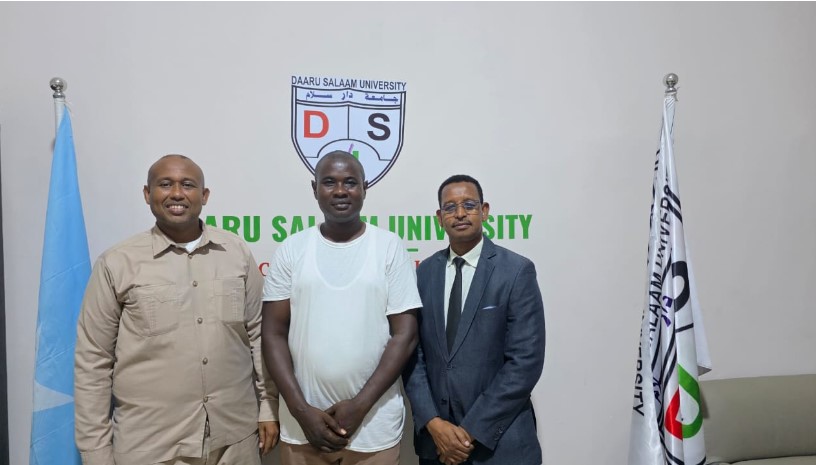
PHOTO: Dr. Yanwoi K. Suborzu, Dean of Extension, Lofa County University (the Author in the middle), DR. ABDI ADAN OUSMAN, VICE CHANCELLOR, ADMINISTRATION/FINANCE AND LEGAL AFFAIRS and Dr. OSMAN MOHAMED HASSAN, CHANCELLOR DAARU SALAAM UNIVERSITY
THESIS SUMMARY
As I prepare to graduate on September 30th, 2026, with a PhD in Business Administration/Management from Daaru Salaam University in Mogadishu, Somalia, after traveling 7,650 KM from Monrovia to Mogadishu, the findings of my doctoral research are unequivocal: Strategic Leadership is the critical missing link between a struggling university and a high-performing university in post-conflict societies.
This two-year empirical case study (2023-2025) was conducted at Lofa County University (LCU), the only public university in northwestern Liberia, established by an Act of Legislature in 2010 to address the growing demand for higher education in Lofa County. The study employed mixed methods to examine how strategic leadership practices influence institutional performance.
The research identifies five core strategic leadership practices that directly correlate with improved organizational performance in higher education institutions emerging from war:
- Visionary Strategic Planning
LCU expanded from 4 to 12 academic programs following the formulation and implementation of its first Five-Year Strategic Plan (2023-2028). The study concludes that universities without a clear strategic plan operate like ships without a compass, particularly in resource-constrained environments.
- Stakeholder Trust – The Somali Lesson
My doctoral immersion at Daaru Salaam University, founded in 2012 during active conflict in Mogadishu, revealed a profound lesson: Somali higher education was rebuilt without World Bank funding, with TRUST as its primary capital. The Hawala system model demonstrates that if trust can move millions of dollars, trust can move institutions. At LCU, performance indicators improved by 40% when leadership institutionalized inclusive governance involving county authorities, market associations, faculty, and student representatives.
- Human Capital Investment
The study found that LCU’s organizational underperformance was linked to a 70% reliance on part-time instructors. Following a strategic decision to sponsor 15 faculty members for Master’s level training, the university’s student pass rate increased significantly from 58% to 82% within two academic years. Human capital remains the most sustainable competitive advantage for universities.
- Financial Innovation and Sustainability
The research confirms that government subvention constitutes only a minimal percentage of LCU’s operational budget, requiring strategic financial diversification for sustainability. Strategic leaders must create alternative income streams. The study documents how LCU’s agricultural extension farms and business enterprise centers are emerging as viable models for financial sustainability in public universities in Africa.
- Youth-Centered Leadership
Between 60-70% of LCU’s staff and student population are youth. The study demonstrates that when youth were entrusted with leadership positions in departments and project committees, institutional innovation, technology adoption, and community engagement increased exponentially. This aligns with the Somali experience where youth do not wait for jobs but CREATE jobs, serving as the hope of the continent.
Conclusion and Contribution to Knowledge:
Liberian universities do not need to replicate Harvard to develop. What they need are strategic leaders who internalize and practice what this study terms “The House of Peace Model” derived from Daaru Salaam University. Do not wait for peace to start school; start school to bring peace; build trust to move resources; and trust youth to lead today, not tomorrow.
Upon my return to Liberia in October 2026 as Dean of Extension, I will initiate the first formal academic bridge program between Daaru Salaam University and Lofa County University. This Africa-to-Africa collaboration will enable Liberian students to learn Somali resilience in post-conflict institutional rebuilding, and Somali students to learn from Liberia’s agricultural and community development value chains.
This is Africa-to-Africa education in practice – From House of Peace to Continent of Hope.
I dedicate this research to Lofa County University and Daaru Salaam University for teaching me that Knowledge Creates Value, Education Transforms Lives, Leadership Builds Nations.
About the Author:
Dr. Yanwoi K. Suborzu is Dean of Extension and Dean, College of Business & Public Administration at Lofa County University, Voinjama, Liberia. He holds an MBA from Cuttington University and a PhD in Business Administration