
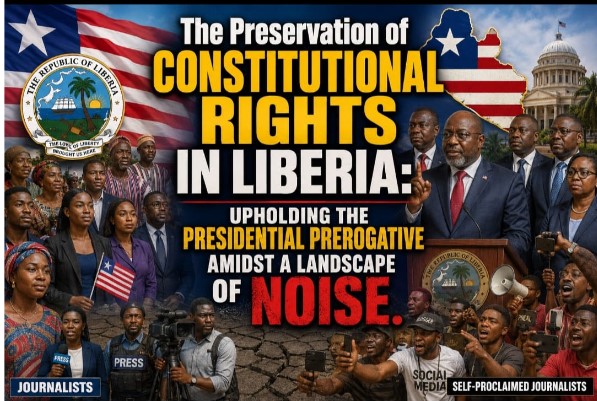
Upholding The Presidential Prerogative Amidst A Landscape Of Noise
By Austin S Fallah – A True Son of the Planet Earth Soil: fallahas@yahoo.com
When Noise Challenges Law: “Every republic eventually reaches a moment when the loudest voices mistake volume for authority. But the Constitution does not bend because the crowd shouts, nor does presidential prerogative disappear because political opponents manufacture a storm of words.
The wise citizen asks, as Socrates would have asked: What is the truth beneath the accusation? And the careful student of power asks, as Machiavelli might: Who benefits when appearances replace reality? Liberia’s salvation lies not in louder rhetoric, but in returning to the law.”
The Constitution Above the Noise:
“Let the marketplace of politics thunder with a thousand voices, yet let the Constitution speak with the final authority. A president may possess the power of office, but that power is not a private inheritance; it is a constitutional trust. Socrates taught us to examine what we think we know, while Machiavelli warned us that appearances can deceive. Liberia must therefore distinguish between the noise of political theater and the substance of constitutional law. For when the crowd drowns the Constitution, democracy becomes a stage upon which power performs without restraint.” — Original reflection inspired by Socrates and Machiavelli.
Journalism Is More Than Being First: “Anyone with a smartphone can be first to post; a journalist must strive to be right. Anyone can repeat a rumor; a journalist must investigate it. Anyone can attack a public official; a journalist must question power without becoming its political instrument. The difference between a social-media commentator and a journalist is not the brand of the phone; it is the discipline behind the work.” — Inspired by the journalistic tradition of truth-seeking and accountability.
The Republic Must Not Become a Rumor: “A nation cannot be governed by rumors, hashtags, political insinuations, or the fever of the moment. The Constitution is the compass; institutions are the vessel; and political power is merely the wind that moves through them. Machiavelli understood that men often judge by appearances, while Socrates insisted upon examination and the pursuit of wisdom. Liberia must therefore resist the temptation to confuse what is loudly proclaimed with what is constitutionally true. A republic survives when facts are stronger than rumors, law is stronger than personalities, and constitutional order is stronger than political noise.”
Protect the Profession, Protect Democracy: “Liberia does not need more people confusing visibility with journalism. It needs more people committed to the responsibilities of journalism. Whether the story is posted from a Samsung, an iPhone, a newsroom computer, or a radio station, the standard should remain the same: seek truth, verify information, minimize harm, act independently, and be accountable. Constitutional democracy cannot be strengthened by noise masquerading as journalism.” — A call for responsible political discourse and ethical journalism in Liberia
Journalism Versus Noise:
“Walter Cronkite understood that journalism had a duty to inform the public, not merely to tell people what they wanted to hear. George Orwell similarly distinguished journalism from public relations by emphasizing truth and accountability. In today’s Liberia, the lesson remains relevant: a social-media page can amplify a voice, but it cannot automatically transform that voice into journalism. The profession must be measured by its standards, not by the number of followers or the sophistication of the smartphone.”
— Informed by the traditions of Walter Cronkite and George Orwell.
The Silence of the Constitution: “Beneath every political storm there is a quieter voice—the Constitution. It does not compete for followers, it does not beg for applause, and it does not need a microphone to possess authority. It simply waits to be read, understood, defended, and obeyed. The politician may command the crowd for a season, but constitutional principles must outlive every politician. Let Liberia beware of those who make noise in the name of democracy while weakening the very constitutional order that makes democracy possible. For when the law becomes secondary to the crowd, the republic begins to lose its soul.”
Social Media Is a Platform, Not a Press Card: “An iPhone in one hand and a Samsung in another do not create two classes of journalists—or two journalists at all. Social media gives people the power to publish, but publication alone is not journalism. The journalist’s responsibility begins where the impulse to post ends: verify the facts, seek the truth, provide context, challenge power, correct mistakes, and serve the public.”
— In the spirit of Walter Cronkite, George Orwell, and modern. journalism
“Whether the person holds a Samsung or an iPhone is irrelevant; a cellphone can record an event, but it cannot manufacture journalistic integrity. Having a phone and a social-media page does not automatically make someone a journalist. Journalism requires verification, fairness, independence, courage, accountability, and a commitment to truth. In Liberia, constitutional rights deserve more than social-media noise; they deserve responsible journalism.” — Inspired by the principles of ethical journalism and the tradition of Walter Cronkite
In Liberia, the presidential prerogative to hire and dismiss, regardless of cause, is not merely a political convenience; it is a constitutional right enshrined in the nation’s legal framework.
This prerogative reflects the foundational structure of governance that empowers the President to maintain a functioning executive branch.
Articles 54 and 56 of the Liberian Constitution clearly define the contours of this power, ensuring that the President, currently Keh-Keh Joseph Nyumah Boakai, has the authority to manage his administration effectively, regardless of fluctuations in public opinion or media scrutiny.
In times of emergency or ongoing investigations, this prerogative becomes even more critical to uphold.
Unfortunately, within this framework, a regrettable trend persists: the proliferation of misinformation and sensationalism by cellphone-tolting individuals masquerading in the corridors of professional journalism, whom I refer to as self-proclaimed journalists who lack the professional integrity to contribute meaningfully to the national discourse.
Social media, while a powerful communication tool, often becomes a megaphone for individuals who prioritize sensationalism over substance.
Such practices muddy the waters for credible journalism and obscure essential conversations about national policy and governance.
As Liberians navigate this cacophony of information, it is vital to recognize the importance of professional journalism in promoting an informed populace and fostering constructive dialogue about the nation’s future.
To fully understand the significance of the presidential prerogative, we must first acknowledge the historical context in which it operates.
The Liberian Constitution has been the bedrock of governance since its adoption, establishing a framework that separates powers while granting the President the responsibility to maintain order and appoint individuals capable of executing the laws of the land.
With a history marked by conflict and instability, Liberia’s constitutional mandates were designed to ensure the country can respond effectively to crises.
This prerogative serves as a tool for the President to ensure competent leadership in critical times.
For instance, during a state of emergency, the President must have the autonomy to make swift decisions regarding appointments and dismissals.
In a nation grappling with issues such as crime and drug trafficking, it is unreasonable to expect an effective executive branch to operate without the flexibility to adjust its personnel based on the evolving circumstances.
Neither a constitutional referendum nor a legislative act has revoked the legitimacy of these constitutional rights; thus, they remain intact and necessary for continued governance.
Critics may argue that exercising this prerogative can lead to abuses of power, pointing to historical instances where leaders have used such rights to stifle dissent and curb opposition.
While it is essential to remain vigilant against tyranny, this concern does not inherently warrant the blanket condemnation of the prerogative itself.
Robust checks and balances, coupled with accountable leadership, are necessary to prevent misuse of presidential powers.
Moreover, public scrutiny and professional journalism play a crucial role in holding leaders accountable and ensuring transparency.
Yet, what happens when the voices in the public sphere are dominated by individuals who prioritize headlines over truthfulness?
In a landscape cluttered with sensational claims and unverified information, disinformation poses a significant risk to the fabric of democracy.
The rise of social media has democratized information dissemination, allowing anyone with a smartphone to share their thoughts.
This accessibility is revolutionary, but it often comes at the cost of the rigorous standards expected of professional journalism.
The distinction between credible journalists and “cellphone self-proclaimed journalists” cannot be overstated.
Professional journalists equipped with ethical training and a commitment to factual reporting provide the vital service of informing society.
They dig deep, engage with sources, verify facts, and contextualize events within a larger narrative.
This diligence enables a well-informed citizenry that can engage effectively with national policy and governance.
In contrast, sensationalist narratives propagated by less credible sources tend to trivialize important issues, focusing instead on scandalous headlines or unfounded rumors.
Such content often lacks the context citizens need to grasp complex national issues fully.
Engaging with this noise distracts from the real conversations that need to be held about national policy, conversations that can elevate public understanding and drive Liberia forward.
For instance, discussions surrounding economic recovery, education policy, and health reform need in-depth coverage that cannot revolve around superficial angles or frivolous distractions.
Liberians must, therefore, exercise discernment in choosing their sources of information, gravitating towards media professionals who have demonstrated a commitment to ethical reporting.
Professional journalists, through their work, can serve as both eyes and ears of society, providing the framework necessary for the populace to engage intelligently with national events.
By elevating these voices above unverified claims and insults, the nation can cultivate a healthy information ecosystem that supports democratic ideals and governance.
Moreover, beyond just discerning the quality of journalism, Liberians must focus on what truly matters in national discourse.
The emphasis should shift toward engaging with key national policies that shape the country’s future.
For instance, open discussions about Liberia’s infrastructure development, public health, and education systems are necessary to foster a shared vision of progress.
Yet, trivial and sensationalist distractions dominate much of the conversation, diverting attention from the pressing issues that affect everyday lives.
A nation can only progress when its citizens are informed and engaged in meaningful dialogue about governance and policy.
This entails both a commitment from journalists to provide quality reporting and a dedication from citizens to engage critically with the information presented.
As we ponder Liberia’s trajectory, all stakeholders must recognize their roles within this ecosystem, emphasizing the need for transparency, accountability, and, ultimately, professionalism in journalism.
As President Boakai exercises his constitutional prerogative, it is incumbent upon all of us, citizens, journalists, and leaders alike, to foster an environment where discourse can thrive.
This involves prioritizing professional journalism that educates and informs rather than sensationalizes.
Liberians must focus on genuine conversations about national policy that enhance the country’s trajectory, rather than allowing themselves to be sidelined by trivialities that offer no substantive value.
The presidential prerogative to hire and dismiss is a constitutional right vital for effective governance in Liberia.
It remains untouched by political upheaval, and in times of crisis, it serves an essential role in maintaining a functioning state.
However, as Liberians engage with their media landscape, they must cultivate a culture that prioritizes credible journalism and eschews the distractions of sensationalism.
Commitment to professional journalism is not merely about preserving a vocation; it is about ensuring that public discourse is informed, constructive, and capable of leading in a positive direction.
By doing so, Liberia can aspire not just to survive amid adversity, but to thrive in its pursuit of progress and development.