
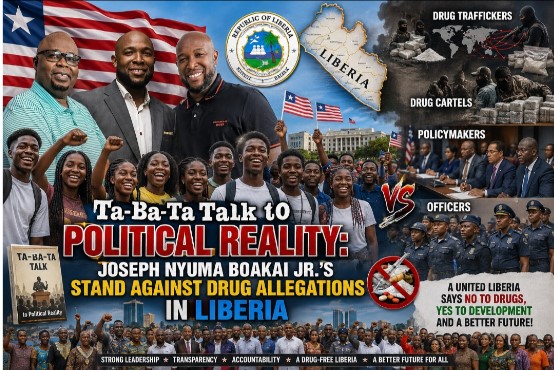
Joseph Nyuma Boakai Jr.’s Stand Against Drug Allegations In Liberia
By Austin S Fallah – A True Son of the Planet Earth Soil: fallahas@yahoo.com
“When Ta-Ba-Ta talk becomes political reality, allegations must be met not with political noise, but with evidence, transparency, and accountability.”
“Joseph Nyuma Boakai Jr.’s stand against drug allegations reminds Liberia that leadership demands courage to confront accusations, uphold due process, and protect the integrity of the nation.”
“In Liberia’s political arena, accusations may generate headlines, but only credible evidence, due process, and the pursuit of truth can determine where political rhetoric ends and justice begins.”
In a world rife with misinformation and political turbulence, the quest for truth often takes a backseat to the sensationalism of baseless allegations.
This theme resonates profoundly in the poignant declarations of Joseph Nyuma Boakai Jr., the son of Liberia’s President Joseph Nyuma Boakai Sr.
In the face of irascible public opinion and ubiquitous media coverage surrounding the allegations of his involvement with drug trafficking and cartels in Liberia, Boakai Jr. stands as a figure shrouded in a mix of vulnerability and resilience.
His assertion that he has “never done drugs in my life and will never do drugs” reflects a phlegmatic approach to the chaos surrounding him, one that underscores the importance of discerning fact from fiction in a politically charged atmosphere.
The backdrop of Liberia is crucial in understanding the ramifications of such scandals.
A nation plagued by historical turmoil, economic distress, and pervasive poverty stands at a pivotal crossroads, where the actions of its leaders can either serve as a beacon of hope or deepen citizens’ despair.
The mention of “ta-ba-ta talk,” as used by Boakai Jr., captures the essence of the environment in which Liberia operates.
Ta-ba-ta, a colloquial term that suggests gossip or slander, indicates the sort of narrative that often overtakes critical discussions on policy and governance.
It epitomizes the distractions that plague Liberia, a country grappling with the need for introspection and accountability, yet distracted by divisive rhetoric and sensational news.
What makes Boakai Jr.’s declarations particularly significant are not only the words he chooses but also the implications behind them.
In a political landscape that can often resemble an impenetrable maze filled with traps laid down by factions with vested interests, his outright denial of drug use and his call for an investigation into the real perpetrators of societal degradation point to an astute awareness of the political game at play.
He recognizes that the focus on his character is not merely an attack on him personally, but rather a calculated distraction from the pressing issues surrounding Liberia’s youth and the systemic problems contributing to the nation’s inestimable poverty levels.
Boakai Jr.’s assertion that these allegations are intended to redirect focus from actual investigations into the true culprits undermining national integrity challenges the narrative constructed by those who would seek to undermine not just his credibility, but the entire administration.
It is a call to action for individuals and institutions to engage with the deeper issues at hand, rather than to succumb to sensationalism.
This sentiment resonates with the concept of akrasia, which describes the phenomenon of acting against one’s better judgment, a descriptive term for both those who propagate unfounded allegations and those who consume them without critical reflection.
His arguments urge the Liberian people and the international community to think critically and rationally about the accusations levied against him, and to sift through the noise to uncover the truth beneath the surface.
The intellectual aspect of Boakai Jr.’s phrasing cannot be overlooked. The idea of “inculpate” versus “exculpate” is acute in his narrative.
Where the former feels like an impending shadow cast by accusations, the latter invokes the innocence he strives to demonstrate.
His statements pose an inherent challenge to the public and to the hearsay-driven empty tautologies on social media alike, urging them to evaluate their propensity to automatically assign guilt in the absence of conclusive evidence or due process.
This need for scrutiny aligns with the broader question of accountability in Liberia’s political discourse.
Moreover, one must consider the ubiquitous nature of misinformation and how relentlessly it spreads, particularly on social media.
Information today often travels faster than fact-checkers can respond, an unfortunate reality that Boakai Jr. recognizes.
This technological age has left leaders and constituents alike in a delicate dance, attempting to discern trustworthy narratives from those fueled by rumor and speculation.
What sets Boakai Jr. apart is his willingness to confront this reality head-on, refusing to let allegations define him or his family’s legacy.
The context in which these declarations were made, at the Handz-On-Barbershop and Phil Musa Intellectual Center in the Midwest of the United States, suggests the importance of community discussions in navigating the complexities of the Liberian narrative.
Hon. Boakai Jr. represents a bridge between the diaspora and the citizens back home in Liberia.
His presence in these communal spaces offers a unique opportunity for Liberians to engage with their identity while grappling with the challenges they face.
It allows for a discourse that extends beyond mere familial ties and delves deeper into the issues that have historically plagued the nation.
A salient observation arises from Boakai Jr.’s comments regarding the degradation of the nation’s youth.
By framing drug trafficking and cartel activity within the context of generational decline and poverty, he neatly casts a spotlight on systemic shortcomings while redirecting domestic attention towards solutions rather than scapegoating.
The use of fissures within the community, or dissension, becomes an unfortunate tactic of those who would keep Liberia from healing; Boakai Jr. plays a vital role in attempting to unify the narrative.
It is a daunting task, as division can often be easier to achieve than unity, especially when credibility is questioned.
Still, the necessity of solidarity in addressing collective issues cannot be overstated.
Viewing Boakai Jr.’s statements through an analytical lens confirms they merit more than a cursory response.
His examination of truth amidst emotional turmoil encourages a socio-political awakening within Liberia and beyond.
Pessimism could easily permeate responses to such allegations.
Still, by demanding investigations into the key players of the drug trade and speaking out against distractions, his words echo a cry for integrity, a return to the foundational principles that ought to guide governance and public service.
The narrative crafted by Joseph Nyuma Boakai Jr. provides a rich tapestry of themes related to truth, resilience, and political accountability.
As Liberia navigates the stormy waters of its socio-political landscape, Boakai Jr.’s commitment to integrity, while urging collective introspection, lays the groundwork for a broader discourse about the nation’s future.
His declarations simultaneously serve as a personal affirmation of commitment to truth and as a rallying cry to the nation to rise above the allure of ta-ba-ta talk.
As suggested, the specter of poverty looms over Liberia; the key to overcoming it lies not in unfounded allegations but in a unified pursuit of justice, personal accountability, and an unwavering resolve to forsake the pervasive influence of misinformation.
Through his astute positioning, Boakai Jr. reveals the pressing need for a nation willing to foster dialogue based on facts rather than sensationalism, paving the way for a society that honors truth above all else.
It is a clarion call echoed across Liberia, a plea for the people to look beyond the chaos and seek the greater good.